AI-Powered AOI Inspection Improves Manufacturing Quality
8/12/2026
Background
Faced with increasing production throughput and more stringent quality requirements, many companies are looking for more consistent, scalable inspection processes. Existing manual and traditional rule-based machine vision inspection methods struggle to maintain accuracy and efficiency at higher production volumes. To address these challenges, edge AI inspection solutions enable manufacturers to detect defects in real time at the point of production, helping reduce quality risks while improving operational efficiency.
Challenges
- Defects are difficult to identify through manual inspection
- Inspection results vary among operators
- Traditional vision systems struggle with complex defect patterns
- Cloud-based processing introduces latency
- Large image datasets increase network bandwidth usage
Solutions
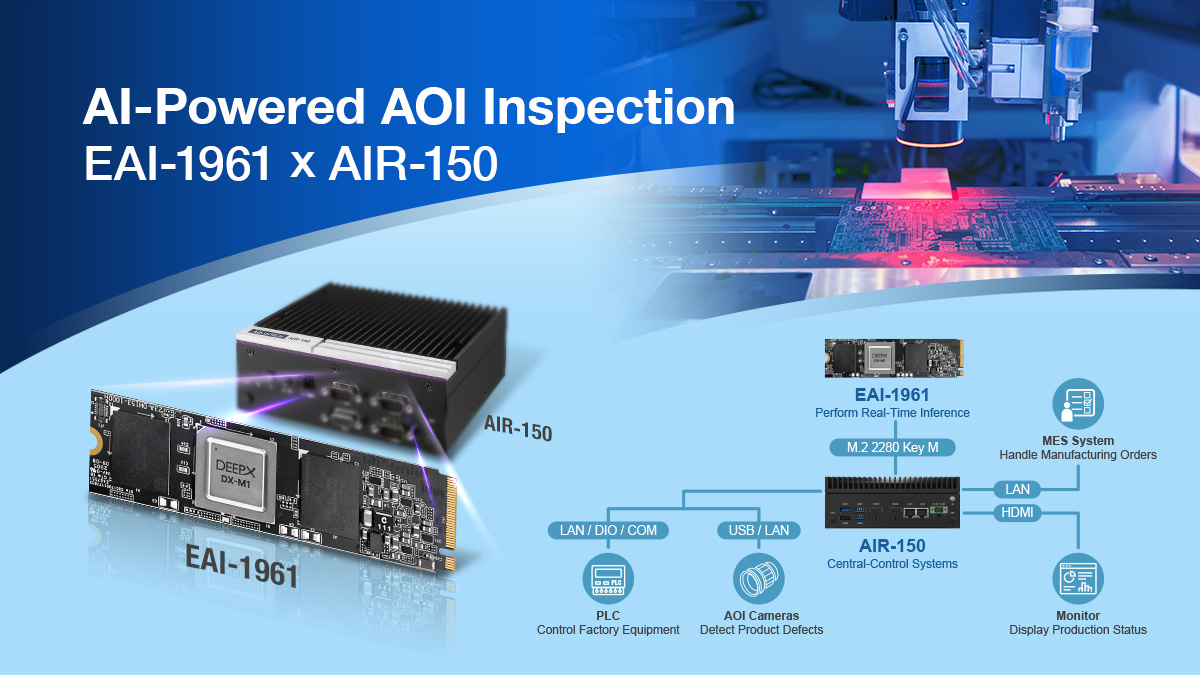
Advantech EAI-1961 is an Edge AI Acceleration Module that delivers up to 25 TOPS of AI performance, enabling advanced defect detection AI models to identify subtle and complex defect patterns with greater accuracy and consistency than subjective manual inspection.
Advantech AIR-150 is an Edge AI Inference System that provides a rugged industrial AI platform for seamless integration of high-resolution cameras and factory equipment through versatile industrial I/O interfaces and dual LAN ports, enabling scalable deployment of automated systems across production lines.
Together, EAI-1961 and AIR-150 perform real-time AI inference directly at the edge, reducing cloud dependency, minimizing latency, and eliminating network bandwidth requirements for high volume image inspection.
Key Functions
Defect Detection
- Scratch detection
- Crack detection
- Surface anomaly detection
Assembly Verification
- Missing component inspection
- Wrong-part detection
- Connector verification
Product Classification
- Good/NG sorting
- Product type recognition
Benefits
- Higher Product Quality: AI continuously inspects every product with greater consistency and accuracy.
- Faster Quality Inspection: Real-time inference enables inline inspection without interrupting production flow.
- Reduced Defect Escapes: Defective products are identified before advancing to the next production stage.
- Data-Driven Improvement: Yield trends and recurring defects are analyzed to optimize manufacturing processes.
-25/AIR-150_03--20231110104228.jpg)
-25/EAI-196120260814133421.png)