

Key Takeaway
Advantech’s Wzzard LRPv LoRaWAN node and WISE-6610 LoRaWAN gateway can facilitate minimizing irrigation water wastage by utilizing LoRaWAN technology to build an efficient, cost-saving system.
Challenge
Approximately 50% of irrigation water is estimated to be wasted due to evaporation or runoff. This occurs because most irrigation systems rely on simple timers. Regardless of whether a drip or sprinkler system is used, the most efficient approach to irrigation is to use water only when necessary, to use the exact required amount, and to ensure that the plants are watered correctly. IoT technology provides a more efficient approach to managing irrigation water.
Solution
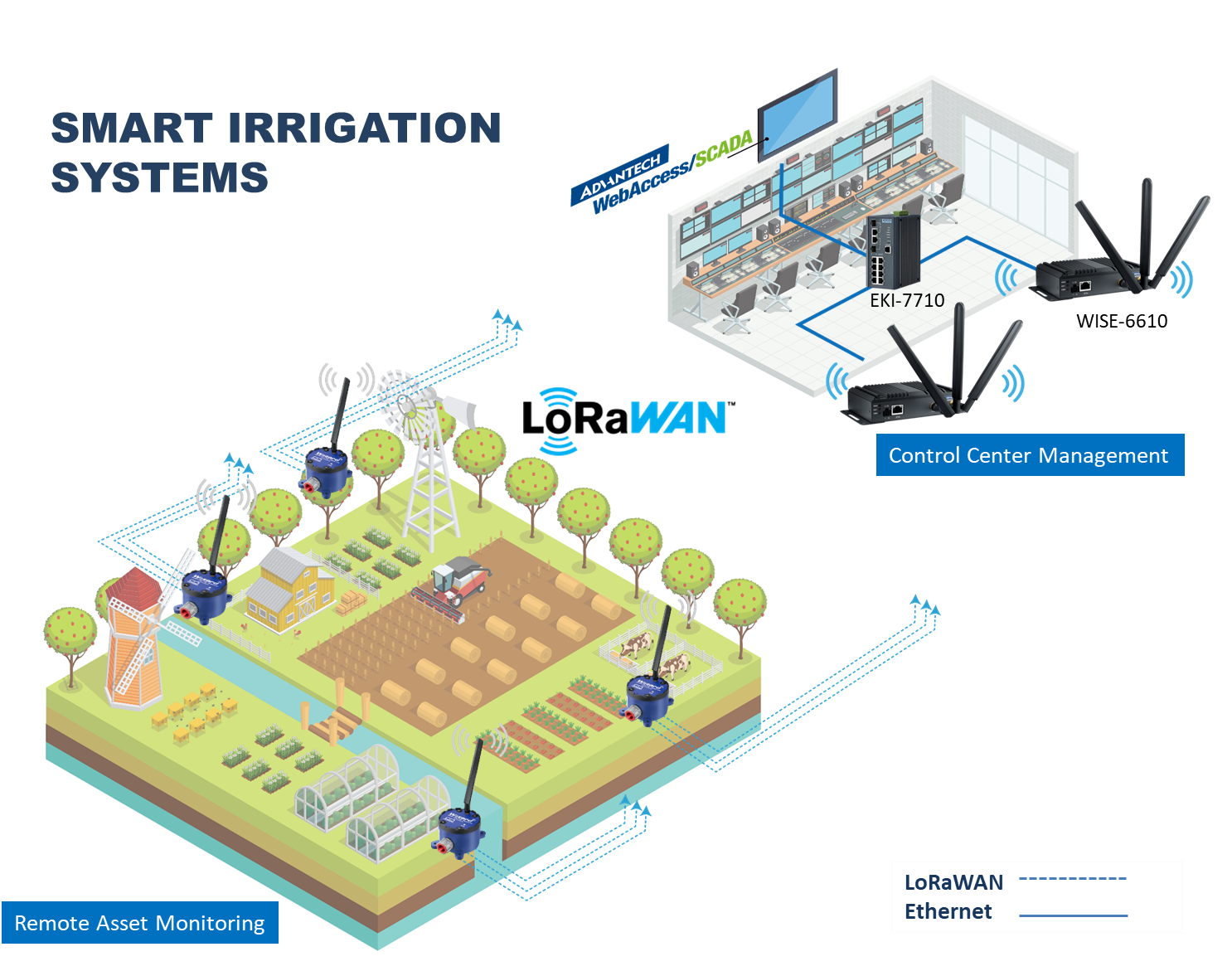
With a smart irrigation system, soil conditions can be monitored in real time by using a low-power wireless Wzzard LRPv sensor network. Wzzard LRPv LoRaWAN nodes transmit data wirelessly to a network gateway, which then sends the data to your PC or Internet cloud applications. The most practical gateway would be able to connect via both wired and wireless networks, meaning that sensor nodes can be positioned in most locations.
Your software can then combine your data with third-party information such as weather reports from national weather services. This enables your system make intelligent decisions about where and when water should be released and how much should be used. For example, the system could release water immediately when no rain is forecasted; in the event ha forecasts predict rainfall, the system could wait, measure the results, and recalculate the amount of required water.
Features, Advantages and Benefits
Establishing a smart irrigation system to help users control, monitor, evaluate, and make decisions requires some knowledge on the key product features so that the most suitable products can be selected to maximize their benefits.
LoRaWAN Wireless Network Technology
LoRaWAN is a proprietary chirp spread spectrum radio modulation technique for use in a low-power wide-area network (LPWAN). It is a WAN specification designed to enable long-range, low-bit-rate communication among “things” (i.e., connected objects) such as battery-powered sensors, and it uses license-free sub-GHz radio-frequency bands such as 196, 433, and 868 Mhz in Europe and 915 MHz in North America. An LPWAN may be used to create a wireless sensor network or a third-party service or infrastructure.
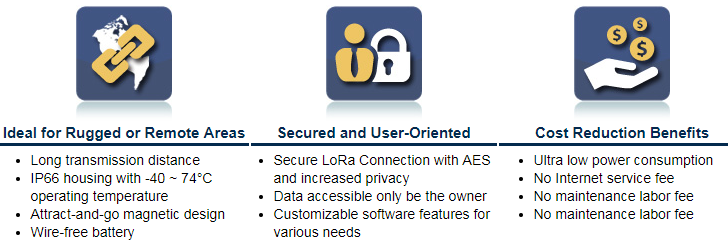
The Wzzard LRPv LoRaWAN node and WISE-6610 gateway support wireless long-range network communication without the need to pay telecommunication fees, thus reducing network operating costs considerably. This is particularly pertinent for reducing the cost of flood monitoring because most water bodies are large and do not have control centers located near them. Furthermore, traditional wireless solutions (e.g., access points) have a limited data transmission range and thus force users to adopt an intensive approach to node deployment. Even though cellular routers are unaffected by such problems, they require paying telecommunication fees.
IP66 Enclosure and Battery/ Solar Design for Remote Outdoor Sites
IP stands for International Protecting Marking, which is a classification system for rating the degree of protection against hazards such as dust and water. With an IP66 rating, The Wzzard LRPv node and WISE-6610 gateway are protected against ingress by and contact with dust as well as powerful water jets. The dual-power design of Wzzard LRPv Node (DC/battery) andWISE-6610 gateway also means that users have multiple deployment options.
Advantech Wzzard nodes are ideal for irrigation sites because the presence of water, mud, high humidity, and airborne water droplets/ dust at these locations poses a constant threat. With its dual-power design, the Wzzard LRPv node frees users from having to install extra cabling and thus reduces costs while simplifying deployment. Additionally, the user-oriented design of the WISE-6610 gateway ensures deployment is user-friendly. This technology does not mean that you need to replace your existing pipes and pumps—incorporating IoT technology into your network does not render your current equipment obsolete; rather, it simply makes your network smarter.
Dual Power-saving Mode and Alarm System
The Wzzard LRPv Node has two power-saving modes: sleep mode (for when a node is not in use) and operation mode (for scheduled data transmissions). For instance, if a node were scheduled to report sensor data twice per hour, then sleep mode would automatically activate when the node is not in use, and operation mode would wake the node when the data must be transmitted, thus achieving the goal of energy efficiency. An alarm system is installed to notify users when a value has exceeded a given threshold. For example, when a flood or storm is approaching, it brings in a tremendous amount of water; in this case, the alarm system will notify users when water levels have exceeded a certain level so that disaster prevention measures can be implemented.
Thus, the smart design of the power-saving modes and alarm system reduces costs by saving power while promoting safety by notifying users when emergent action should be taken.

Conclusion
Advantech's LoRaWAN solution, a highly integrated LoRaWAN sensing platform for applications ranging from I/O sensor data management to network protocol conversion, can be utilized to form a sensor network, paying immediate dividends by cutting maintenance costs while increasing overall productivity. Wzzard LRPv network gateways connect to your application server or SCADA for data access using the MQTT protocol via either an Ethernet or wireless data network.
The described features make it possible to place sensors and Internet gateways in locations where AC power or wired Ethernet is unavailable, and the high flexibility of the dual power-saving modes and alarm system can minimize costs by conserving power and preventing disasters.
Product Information
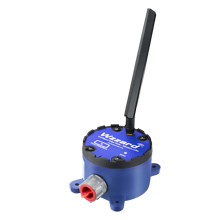
- Rugged, IP66-rated, fiber-reinforced polyester PBT enclosure
- Ultral ow power consumption with battery and external power input (3.7 ~ 12 V)
- Industrial-grade with a wide operating temperature range (-40 ~ 75 °C)
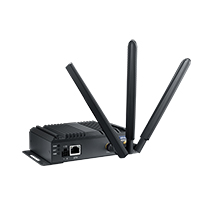
- Existing software user modules plus fully supported application development gives more customization options for users
- Low power consumption
- Industrial-grade with a wide operating temperature range (-40 ~ 75 °C)
- Supports IoT protocols