Advantech Partners with Spingence to Drive Physical AI in Robotic Retail Automation
19.03.2026
As generative AI matures, industry focus is shifting to the more demanding field of Physical AI—bringing AI into real-world environments to collaborate with humans and perform complex tasks. To meet this trend, Advantech partners with Spingence Technology and NVIDIA ecosystem partners to deploy NVIDIA Omniverse™ robotic applications, leveraging integrated hardware-software solutions and environment simulation technologies to accelerate intelligent transformation.
In retail environments, this means AI must not only understand its surroundings but also operate effectively in dynamic physical spaces—performing tasks such as restocking, shelving, and inventory management. Addressing this challenge, Spingence Technology’s client, Vicomm Technology, has demonstrated the practical potential of Physical AI with its smart retail service robots. Using NVIDIA Omniverse™ to simulate real-world retail scenarios, robots are trained virtually before executing tasks like restocking and shelving in actual stores. This approach not only helps tackle the long-standing labor shortages in retail but also marks a new industry stage, as AI progresses from “understanding the world” to “participating in the world.”
From Command Center Dashboards to Physical AI: The Turning Point of Digital Twin Value
“Digital twin technology is key to realizing Physical AI, but the concept has actually been around for many years,” said Ken, General Manager of Vicomm Technology. Early digital twin applications focused on command center dashboards, allowing managers to monitor equipment or facility status in real time, but they did not actively participate in task execution. Their value remained largely at the visualization level.
The true turning point came as AI and physical simulation capabilities matured, particularly with the launch of the NVIDIA Omniverse platform. Digital twin applications shifted from Real-to-Simulator to Simulator-to-Real—robots can now undergo extensive virtual training to learn how to perform tasks and handle various scenarios before deploying the results in real-world environments. This approach replaces the traditional development model that relied on engineers manually coding rules and calibrating systems.
Ken believes that traditional rule-based approaches are not only costly and time-consuming but also difficult to scale, limiting robots to relatively simple tasks. In contrast, the virtual-to-real integrated environments built with NVIDIA Omniverse allow robots to train iteratively, enhancing their task-execution capabilities. This enables them to handle highly uncertain and complex operations, opening up new possibilities for automation in industrial and retail settings.
Why Retail Is the Ultimate Testing Ground for Physical AI
In retail automation, labor shortages have become one of the biggest pressures in recent years, particularly in certain regions or operating hours, such as night shifts. Even with higher wages, it remains challenging to fill staffing gaps, making automation the optimal solution to overcome this challenge.
However, current retail automation mainly focuses on the front end, such as self-checkout systems, to reduce labor in the transaction process. Back-end operations—including restocking, shelving, and removing expired products—still heavily rely on manual labor. This is exactly the pain point addressed by smart retail service robots developed by Vicomm Technology.
Ken explains that retail stores are highly diverse and dynamic environments. Products vary greatly in quantity, size, material, and packaging, and are frequently rearranged for promotions or seasonal changes. Training robots to handle these items using traditional rule-based methods requires engineers to define rules and action logic for each product type, resulting in long development cycles, high costs, and limited scalability.
To address this, Vicomm Technology chose NVIDIA Omniverse as its primary development platform. Built on USD (Universal Scene Description), NVIDIA Omniverse can create virtual environments that closely mimic the real world, enabling robots to perform millions or even billions of pick-and-place training iterations. The platform also allows precise configuration of physical parameters—including size, weight, surface friction, and material properties. Even for flexible-packaged items like chips or bread, NVIDIA Omniverse can accurately simulate their physical behavior, allowing robots to iteratively optimize their grasping strategies in the virtual environment. This ensures stable and reliable performance when deployed in real-world retail settings.
From Software Simulation to Hardware Selection: Ensuring Stable Robot Operations in the Real World
Transitioning from virtual scenarios to real-world stores is not as simple as downloading a model onto a robot. Rong hui Lin, Innovation Team Leader at Spingence Technology, points out that the real challenge lies in minimizing the gap between virtual and physical environments, ensuring that training results can reliably translate into actionable movements on site.
First, virtual environments must closely replicate real-world conditions. Details such as shelf height, product density, lighting variations, and traffic flow all affect a robot’s perception and grasping decisions. Even extensive AI training cannot compensate for discrepancies between virtual models and actual stores, which may lead to misjudgments or operational errors. Therefore, the team continuously compares the virtual setup with actual store conditions, adjusting parameters and scene configurations to establish accurate correspondence.
Second, extensive environmental testing is required, along with close collaboration with store personnel. The team identifies potential real-world scenarios—such as temporarily blocked aisles or relocated products—and simulates them virtually to assess whether the robot’s responses and decision logic are appropriate, ensuring reliable performance during actual operations.
Beyond scene construction and environmental testing, hardware is equally critical to robot stability. Retail operations demand uninterrupted service; frequent system downtime or manual intervention not only reduces efficiency but also undermines the value of automation. Therefore, when designing the overall solution, the team must consider computing performance and long-term operational stability, preparing for scalable deployment in the future.
Advantech Builds the Critical Computing Foundation for Physical AI with Comprehensive Product Line and Reliability
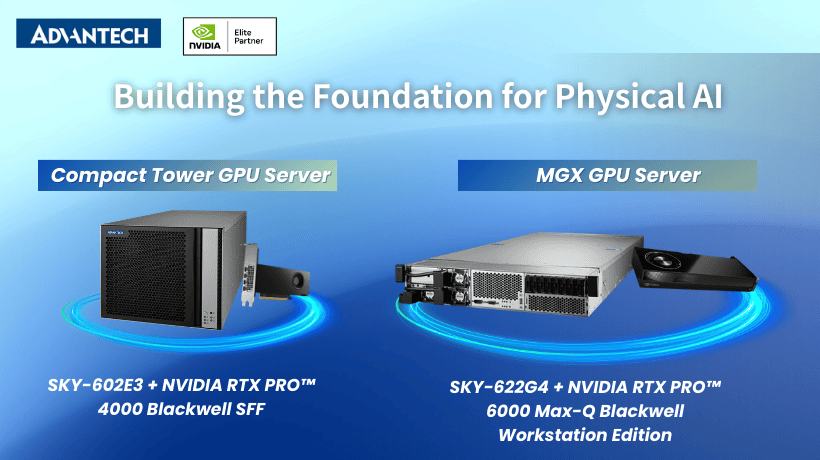
As an NVIDIA Elite Partner, Advantech offers a complete product line and integration expertise in GPU servers and edge computing, providing a stable computing foundation for Vicomm Technology’s ongoing projects.
For example, Advantech’s compact tower GPU server, SKY-602E3, delivers flexible scalability and high-performance computing, making it suitable for deployment in small- to medium-sized retail stores. The newly launched NVIDIA MGX™ GPU server, SKY-622G4, supports NVIDIA RTX PRO™ 6000 Blackwell Max-Q Workstation Edition GPUs, meeting diverse AI and high-performance computing needs while also enabling Physical AI simulation applications based on NVIDIA Omniverse.
Ronghui Lin admitted that in past projects, Spingence Technology had used hardware from various brands, only to repeatedly encounter system instability or unexpected shutdowns. This led clients to initially question the reliability of the software, requiring the team to spend significant time troubleshooting the root causes.
These experiences have made Spingence Technology place greater emphasis on hardware stability and technical support when planning subsequent projects, leading to a long-term and close technical collaboration with Advantech. For the current smart retail service robot application, Spingence Technology has begun evaluating the feasibility of deploying Advantech GPU servers and has conducted practical testing.
Ken also noted that choosing hardware brands with industrial-grade design and comprehensive technical support helps reduce integration risks and future maintenance costs. As a result, Advantech will be prioritized as a hardware partner in future projects, establishing a more standardized and replicable computing foundation for smart robot applications.
Looking ahead, Vicomm Technology will continue to enhance the capabilities of its smart retail service robots and gradually expand into other labor-intensive sectors, such as bubble tea stores, cleaning operations, and long-term care facilities. Advantech will further deepen its collaboration with Spingence Technology and Vicomm Technology, providing reliable hardware and technical support for extended operations, accelerating the real-world deployment of Physical AI, and enabling a more resilient and efficient future for automation applications.
-25/RTX-RPO-6000--Max-Q-Blackwell20250502143517.png)
-25/SKY-602E320240201102210.png)
-25/RTX-PRO-6000-Blackwell20250415101918.png)
-25/RTX-PRO-4000-SFF-Blackwell20250827102850.png)
-25/RTX-RPO-4000-Blackwell20250319114127.png)