Key Takeaway
Learn how PitoTech and Advantech use digital twin simulations to enhance manufacturing efficiency, flexibility, and smart factory transformation.

Facing workforce shortages, geopolitical risks, and rising operational costs, manufacturers are actively seeking more precise approaches to production line planning and resource allocation to maintain stable operations and enhance overall efficiency. To address these challenges, factory automation and system simulation expert PitoTech has partnered with Advantech to develop an integrated, one-stop digital twin solution that combines both software and hardware. This collaboration enables manufacturers to accurately simulate real production line operations using virtual digital twins, optimizing line design, reducing trial-and-error costs, and improving productivity and flexibility—laying a solid foundation for smart manufacturing transformation.
Three Key Application Scenarios of the Digital Twin Simulation System
PitoTech began introducing system simulation into factory production management as early as 1992—more than 30 years ago. By leveraging real operational data for logical computation, the company has helped enterprises optimize processes and resource allocation while accumulating extensive practical experience across a wide range of industries, including the electronics manufacturing, semiconductors, flat panel production, textiles, footwear, machining, food processing, and warehousing logistics. This deep industry knowledge enables PitoTech to develop simulation models that closely reflect the actual production characteristics of each sector, supporting more accurate decision-making in automation deployment, line configuration, and workflow optimization. In recent years, PitoTech has further integrated the NVIDIA® Omniverse™ platform to visualize simulation logic and outputs. With a more intuitive and user-friendly interface, users can quickly interpret complex production scenarios and gain critical insights at a glance.
Currently, digital twin simulation systems are applied in manufacturing across three main scenarios. The first scenario involves full-factory planning before establishing or expanding a facility, enabling companies to clearly understand production capacity limits, allocate production line resources, and plan internal workflows.
Jia-Tsuo Huang, Vice President of PitoTech, explained that in recent years, many manufacturers have set up factories in the United States, where higher labor costs and different operational practices make it difficult to fully replicate the planning of their Taiwan facilities. In such cases, a digital twin simulation system can create a virtual factory to model machine layouts, staffing levels, and automation ratios, allowing companies to evaluate production performance and cost-effectiveness under different strategies in advance, and thereby formulate the optimal plan.
For example, an e-commerce company planning a large-scale logistics warehouse initially intended to purchase 70–80 Automated Guided Vehicles (AGVs). However, simulation analysis revealed that having too many AGVs could lead to traffic congestion within the facility. The company ultimately adjusted the plan to 50–60 AGVs, achieving optimal efficiency and saving approximately NT$20 million. Moreover, the enterprise used simulation results to devise a phased procurement strategy, avoiding unnecessary waste caused by idle equipment or by tying up capital too early through one-time bulk purchases.
The second application scenario involves validating the execution of production plans to enhance decision-making accuracy and resource utilization while reducing trial-and-error costs during actual deployment. For instance, a manufacturer built a new automated production line with an expected daily output of 1,000 units, but initial operations only achieved 300 units per day. By leveraging a digital twin simulation system to reconfigure the production workflow, the company improved resource utilization and increased output to over 700 units per day without changing any equipment. After adjusting equipment allocation based on the simulation, daily production further increased to 1,500 units.
The main cause of these discrepancies lies in the complexity of manual planning, which must simultaneously account for labor hours, machine allowances, equipment downtime, and other dynamic factors. This often leads to mismatches between projected and actual performance. This case clearly illustrates that by using a digital twin simulation system from the very beginning to configure production workflows, companies can analyze capacity, operational planning, and potential bottlenecks in advance, enabling optimal decisions early on rather than discovering errors in equipment quantity or layout only after deployment.
The third application scenario is enhancing decision-making for production scheduling and line operations. For manufacturers, the adage "plans cannot keep up with changes" represents one of the greatest challenges in shop-floor management, especially when facing line changeovers or last-minute customer orders. With a digital twin simulation system, companies can perform predictive analyses before schedule adjustments, assessing the impact on overall production capacity, potential delivery delays, and workforce load. This allows managers to monitor risks in real time and implement the most suitable scheduling strategies.

(Image source: PitoTech digital twin model, built on the NVIDIA Omniverse platform)
From “Unable to Run” to “Real-Time Computation”: Advantech GPU Servers Bring Digital Twins to Life
In any of the scenarios described above, Advantech GPU servers are key to visualizing the results generated by the simulation logic.
According to Jia-Tsuo Huang, Vice President of PitoTech, digital twin simulation systems require extensive logical and data computations. With the integration of the NVIDIA Omniverse platform, which involves 3D graphics and AI-based simulations, computational loads become even more demanding. Only by running on a high-performance computing platform can simulation results be delivered in real time and with stability.
As an NVIDIA Elite Partner, Advantech gains zero-delay access to the latest NVIDIA RTX™ GPU, combined with high-performance platforms for customer validation. Advantech GPU servers offer powerful computational capacity and stable architecture, enabling fast rendering of simulation results on screen and more detailed visualizations. This not only maximizes the value of digital twin simulations but also provides a superior user experience.
Huang noted that in the past, computations were often carried out on hardware provided by clients, which frequently failed to handle the workload or required excessively long execution times. For example, a client once used a laptop with a discrete GPU for simulation, resulting in a single computation taking several hours to days.
These experiences reinforced PitoTech’s conviction that achieving both high simulation performance and quality visual rendering requires professional high-performance server architecture. Huang emphasized, “Especially when clients want not only people-flow or logistics analysis, but also smooth, realistic factory simulations on the Omniverse platform, we know that a strong hardware foundation is essential.”

(Image source: PitoTech digital twin model, built on the NVIDIA Omniverse platform)
Dual Engines of Product and Service: Advantech and PitoTech Support Digital Twins with Unmatched Reliability
Jia-Tsuo Huang further emphasized Advantech’s dual strengths in both product and service. The first strength lies in extensive experience and a comprehensive product lineup. Typical hardware often struggles to handle both the real-time rendering and the computational demands, and most users are not familiar with high-performance computing platforms. With long-standing expertise in industrial computers and Edge AI, Advantech understands the computational needs and challenges manufacturers face in smart transformation. Its solutions not only meet the majority of customer configuration requirements but also provide optimized configuration recommendations.

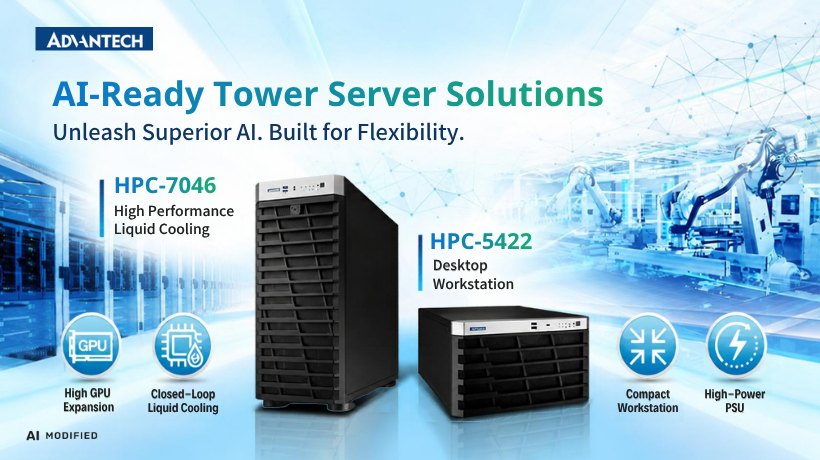
Equally important, the Advantech GPU server HPC-5422 features a flexible architecture capable of accommodating different generation or numbers of GPU cards. This allows PitoTech to configure the most suitable GPU server according to the scale of a digital factory and the complexity of its models, enabling faster computation, finer visuals, and more realistic factory dynamics. In addition to tower servers, Advantech also offers rack-mounted GPU servers that support multiple high-wattage GPU cards, catering to various AI applications.
The second strength is comprehensive and real-time service support. Beyond its products, Advantech provides full technical support to assist PitoTech in addressing challenges during system deployment. Huang shared that during a previous project, a client initially tested the system using two non-industrial GPUs. Due to the large scale of the digital factory, the simulation visuals experienced significant lag. Upon learning this, the Advantech team not only provided the server with NVIDIA RTX PRO™ 6000 Blackwell Max-Q Workstation Edition for testing but also went on-site to assist, enabling PitoTech to quickly overcome performance bottlenecks.
Looking ahead, PitoTech and Advantech will continue to deepen their strategic partnership, focusing on three core areas: smart manufacturing, digital twins, and AI-driven decision-making. By integrating both companies’ strengths in edge computing, data acquisition, simulation and analysis, and decision optimization, they aim to advance an AI-powered smart factory decision-support platform. Leveraging Advantech’s WISE-Edge Link and Pito’s AnyLogic simulation system, the platform creates a visualized, real-time decision environment. Advantech’s Smart Manufacturing Center in Linkou serves as a demonstration hub, showcasing the full process from data acquisition and simulation forecasting to decision execution, accelerating Taiwan’s manufacturing sector toward a high-performance, data-driven era of intelligent transformation.