Digitalization and Process Optimization in the Food & Beverage Industry
06/05/2026

In the Food & Beverage industry, digital transformation is a key driver for enhancing operational efficiency and process control. This case study outlines the journey of an Italian company that leveraged advanced technology integration to optimize its production and logistics processes, achieving measurable improvements in performance, reliability, and operational consistency.
Client Profile and Operational Environment
The project involved a leading Italian company in the Food & Beverage sector, with a well-established presence across both domestic and international markets and a broad network of production facilities distributed throughout the country. Operating in a highly competitive, efficiency-driven environment, the company was facing increasing complexity in the management of its production and logistics operations.
Over time, the accumulation of heterogeneous systems and the presence of legacy equipment lacking native connectivity led to several operational inefficiencies, particularly within warehouse processes. Picking and shipping activities were frequently slowed down by manual errors, while the absence of real-time data limited the company’s ability to maintain a complete and reliable view of the supply chain. In addition, limited batch traceability represented a critical challenge in an industry where product quality and regulatory compliance are essential.
Project Requirements and Objectives
In response to these challenges, the company launched a digital transformation initiative aimed at modernizing its technological infrastructure without replacing its existing assets.
To achieve this, a brownfield approach was adopted, focused on integrating and enhancing the systems already in place.
The customer’s primary objectives included establishing reliable and continuous data collection, improving operational efficiency by reducing manual errors, and gaining greater visibility across every stage of the supply chain.
At the same time, the company identified the need for advanced quality control and predictive maintenance tools capable of detecting anomalies early and minimizing unplanned downtime
The Implemented Solution
To address these requirements, a distributed architecture was designed and implemented, capable of intelligently connecting the company’s various operational layers.
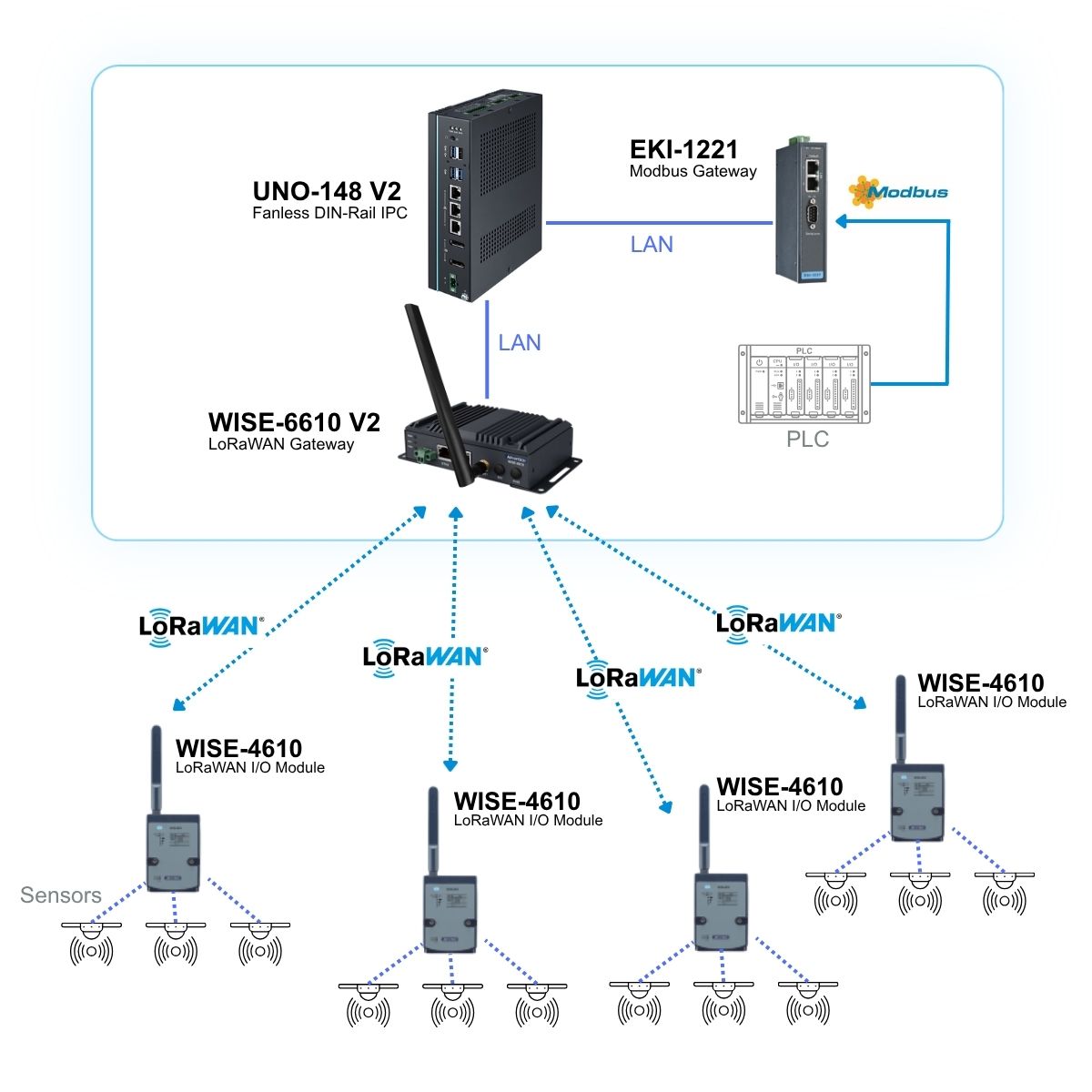
At the core of the solution lies the UNO-148 V2 Industrial Edge Computer, used as the primary node for data collection and on-line processing directly at the production line. This device enables real-time acquisition of information from multiple sources, minimizing latency and ensuring operational continuity even in the event of network interruptions.
The infrastructure was integrated with existing management systems such as MES and WMS, enabling continuous synchronization of information and more efficient handling of logistics operations. At the same time, to overcome the limitations of legacy equipment, EKI-1221 Modbus gateways were introduced, capable of converting RS-485 serial protocols into Ethernet-based communications. This made it possible to bring even older machines into visibility within SCADA environments and cloud platforms.
A further distinguishing element of the solution concerns both environmental monitoring in the curing rooms, where parameters such as temperature, humidity, and airflow must be continuously controlled, and the monitoring of rack location occupancy within the warehouse. To this end, WISE series gateways and wireless modules were deployed, transmitting data over a LoRaWAN network. This ensures long-range coverage while maintaining extremely low power consumption.
System Components
- UNO-148 V2 - Fanless DIN-Rail Edge Controller feature with 13th Gen Intel® Core™ i CPU
- EKI-1221 - Gateway Modbus RTU/Ethernet - 1-Port Modbus Gateway
- WISE-6610 V2 - LoRaWAN® Enabled Gateway
- WISE-4610 - LoRaWAN® Enabled IoT Wireless Modular I/O
System Diagram
Results Achieved
The introduction of the new infrastructure led to significant, measurable improvements in a relatively short period of time. In particular, order fulfillment times were reduced by up to 15–20%, thanks to greater efficiency in picking and shipping processes. Likewise, operational errors decreased by 20–30%, contributing to an overall improvement in system reliability.
The availability of real-time data also enabled the company to gain a clearer and more comprehensive view of the supply chain, streamlining decision-making processes and increasing overall operational control.
The Value of the Advantech Solution
The success of the project was made possible by the adoption of robust, scalable technologies that are fully integrated with one another. Advantech solutions demonstrated high reliability in complex industrial environments, while also providing the flexibility required to adapt to continuously evolving operational needs.
The use of edge computing enabled optimized data management, reducing dependence on the cloud and improving overall system performance. The ability to seamlessly integrate legacy devices also helped contain investment costs by avoiding the need for a full replacement of existing infrastructure.
Overall, the project stands as a clear example of how a gradual and well-structured approach to digitalization can generate tangible value, enhancing operational efficiency, process quality, and the company’s long-term competitiveness.
Business Impact
- Reduced operational costs
- Increased productivity
- Improved product quality
- Enhanced process control and visibility
- Optimized maintenance operations
Key Success Factors
- Brownfield approach to leverage and enhance existing assets
- Modular and scalable architecture
- Full IT/OT integration
- Use of edge computing to reduce latency and cloud dependency
- Progressive introduction of advanced technologies
Why Advantech
- High industrial-grade reliability of devices
- High-performance, scalable edge computing solutions
- Extensive integration capabilities with legacy systems
- Support for standard industrial protocols (Modbus, Ethernet, LoRaWAN)
- Comprehensive ecosystem for industrial digital transformation
- CRA Ready
-25/UNO-148-V2_03--20240328182430.jpg)
/EKI-1221_Front right _S20180125181744.jpg)
-25/WISE-461020240702102109.png)
-25/WISE-6610_02--20240202160416.png)