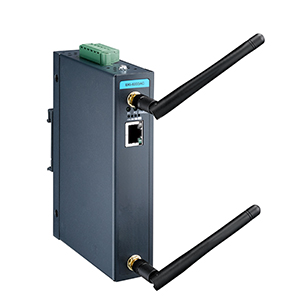
Ground Control System
The ground control system is the part installed in the factory/warehouse floor that is creating the reference environment and communications to make AGVs (every system is composed of several of them) able to operate perfectly. From one side, the ground control system is offering coordination among the different mobile agents. On the other side, the ground system takes inputs coming from external systems (bring part A from location X to location Y), and passes these as instructions to a specific AGV.
This part is the base of a perfect AGV solution and it requires high computational power; that is why Advantech has identified specific solutions as recommended best fit. For control units installed in a rack, we suggest the ACP-4320 with AIMB-786. This provides a powerful system (up to 9th generation of Intel Core I CPU) and PCIe expansion capabilities. If the installation is not using a dedicated cabinet, in order to have the maximum reliability, the MIC-730 can be used. This offers completely fanless operation that can withstand dusty environments and still deliver the needed computational power. The unit provides the flexibility of adding additional cards thanks to its iModule technology (different variants of backplanes can be easily selected and plugged in).
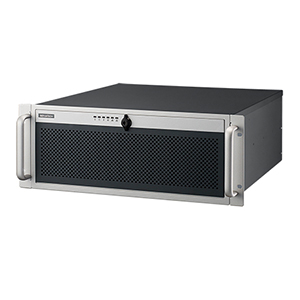
ACP-4340
4U Rackmount Chassis
for Full-size SHB/SBC
or ATX/MicroATX
Motherboard with
4 Hot Swap Drive Trays
Learn More
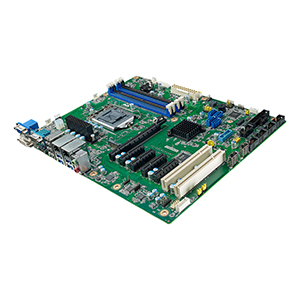
AIMB-787
LGA1200 10th
Generation Intel® Core™
i9/i7/i5/i3/Pentium®/
Celeron® ATX with DP/DVI/VGA,
DDR4, USB 3.2, M.2,
SATA 3.0
Learn More
Mobile Control System
Wireless communications nowadays is becoming increasingly popular for factory and process control automation systems. The localization and tracking of components, the coordination of autonomous transport vehicles and mobile robots, as well as applications involving distributed control, are all areas in which wireless technologies could be used in an industrial environment. Mobile robots and AGVs have been used for many years to move materials within industrial facilities. The early AGV implementations followed a floor mounted magnetic or radio-frequency track, and frequently performed simple point-to-point transports with a known schedule or takt time. Nowadays, PLC centric systems, embedded PC with PLC solutions, autonomous mobile robot solutions, and programmable automation controllers can all benefit from the use of wireless communication technologies.
-
PLC Centric System
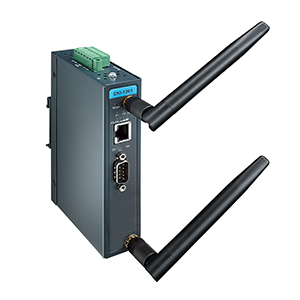
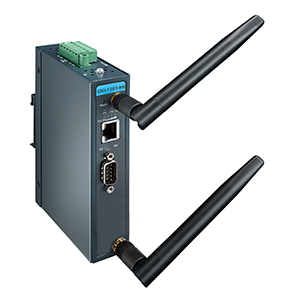
In a PLC centric system the whole control system is managed by a programmable logic controller (PLC) running real-time control acquiring the different parameters and determining which the output (speed and direction). Reliable wireless communication is essential and Advantech offers a number of industrially qualified WiFi solutions including options for serial communications over WiFi such as the EKI-1361.
-
Embedded PC with PLC
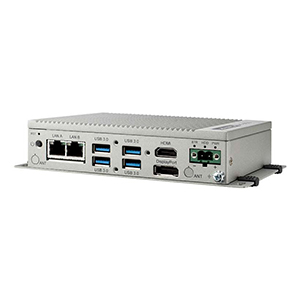
Embedded PCs with PLC are the second popular topology. This option still uses the PLC for the control tasks of the vehicle but uses the embedded PC as a flexible solution to integrate the algorithms coming from the base station. Vehicle control is nowadays not a problem but the effort of the different players relies on the software developed to optimize the journeys in order to provide the best system efficiency. Not all embedded PCs fit with these requirements however: space is a major constraint as well as vibration. Having a slim and compact flat design allows best-in-class vibration protection as well as the required cable retention system. Also important is support for ‘non-PC’ interfaces such as CanOpen. All these specifications can be found in the UNO-2000 series, providing a wide CPU availability to meet the required computational power, and easy expansion via its iDoor technology.
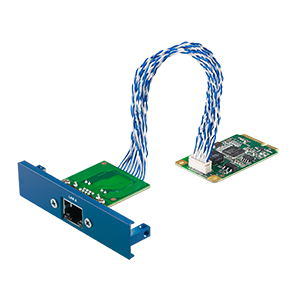
iDoor Series
Various I/O expansion modules include Fieldbus
Learn More
protocol, smart sensor, communication and memory -
Autonomous Mobile Robot
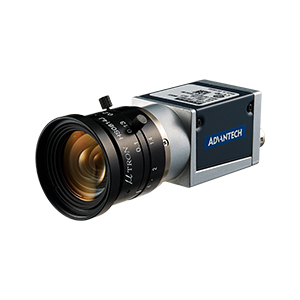
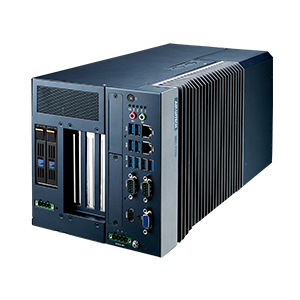
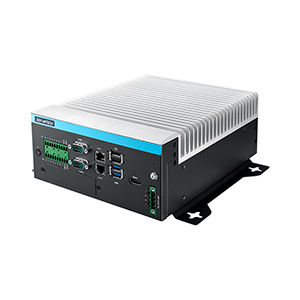
One of the robot applications in smart manufacturing is the vision guided autonomous vehicles (AGVs). They are used to move objects from one part of the plant to another. Integrated with industrial cameras, wireless communication and an industrial PC, the autonomous mobile robots can see and determine their trajectory in real-time, and perform required operations in factories and heavy duty applications. Advantech’s industrial cameras, Quartz and MIC-770 series are the ideal system to complete the 2D/3D sensing, control, and communication for autonomous mobile robots. With the latest video AI technology, MIC with a GPU and iModule provide customers with an ideal solution.
-
Programmable Automation Controller
The most innovative solution is the programmable automation controller (PAC), which combines the real time behavior of a PLC with all the required physical I/O, together with the flexibility provided by an industrial PC. A single compact device unifies both the PLC functionality (via a soft PLC capability powered by Codesys) and the latest industrial Intel Core I platform. Advantech’s AMAX-5580 is a perfect example of this innovative approach.
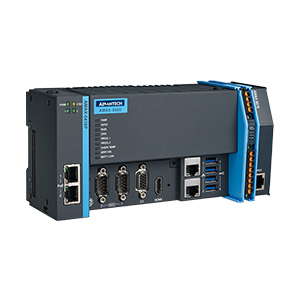
AMAX-5000 Series
EtherCAT Slice I/O and controller is designed
Learn More
with the smallest programmable automation
controller (PAC) in the Core i class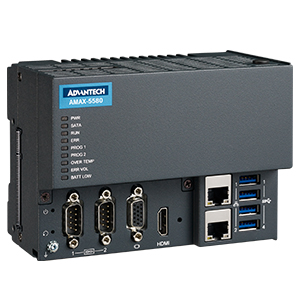
Communication Infrastructure
Communications are the vital part that keeps the entire solution alive and running. When dealing with mobile components, it’s natural to select wireless based on two requirements: Reliability: as the system must be connected all the time. Signal strength: meaning all the information must flow without any interference issues. Communication issues will also impact performance after deployment resulting in operational downtime and cost.
-
AGV-Embedded Device Connectivity
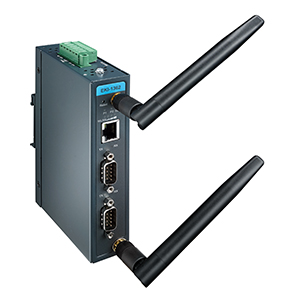
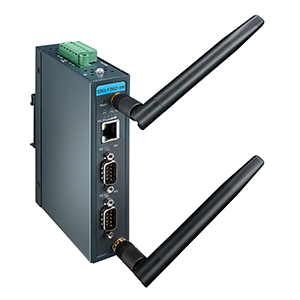
The industrial wired and wireless communications are two important transmission methods that provide AGVs a seamless, uninter rup ted intercommunication between various embedded devices.
[Wi-Fi Client requirement]
* Support for Ethernet port, serial port, and Modbus protocol
* Ruggedized design for harsh environmental conditions
* P2P communication
* Remote data requesting and command issuing
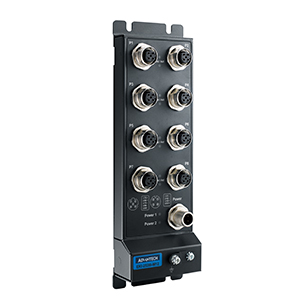
* High security authentication[Ethernet switch requirement]
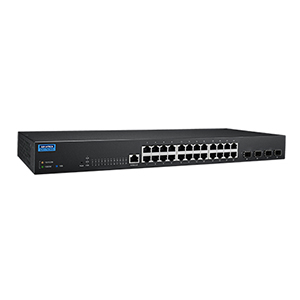
* Perfect for PLC applications
* IP67 for harsh environment
* Rugged duration for vibrational environment
-
Moving AGV to Ground Network Transmission
An ideal AGV should come with obstacle avoidance capability to intelligently move between manufacturing lines. This goal heav ily relies on a reliable wireless network communication between the mobile AGV and its environment.
[Wi-Fi AP requirement]
* High compatibility with any third party Wi-Fi AP
* Dual-band Wi-Fi 2.4Ghz / 5.8Ghz
* Fast roamingAdvantech is able to offer a complete infrastructure system (using the EKI-6333AC-2G), the base station is an industrial access point with MIMO (high throughput), and dual frequency ideal for harsh environment operations.