

Key Takeaway
Discover Advantech's scalable gaming platforms for casinos, focusing on steady hardware evolution, AI-ready performance, and compliance at ICE 2026.

Scalable Gaming Platforms for Modern Casino Environments
Craig Stapleton, Product Director for Advantech’s Gaming Solutions division, explains why incremental hardware gains matter more than quantum leaps
As casino technology continues to evolve, operators and gaming OEMs are seeking high-performance gaming platforms that deliver long product lifecycles, regulatory compliance, and AI-ready performance. At ICE 2026, much of the industry conversation shifted away from hype and toward practical execution, focusing on how casino hardware can reliably support next-generation game content, multi-display configurations, and real-time data processing.
In a recent interview with G3 Newswire, Craig Stapleton, Product Director for Advantech – Gaming Solutions, explains how Advantech is shaping the future of casino hardware and industrial PCs for gaming. Rather than pursuing short-term disruption, the company’s approach centres on scalable gaming platforms engineered for stability, compliance, and long-term deployment in regulated markets.
Advantech’s strategy prioritises steady platform evolution — enhancing graphics capability, processing performance, and system expansion while maintaining the reliability operators depend on. The objective is clear: equip casino operators and gaming manufacturers with industrial-grade computing solutions ready for AI integration, advanced graphics workloads, and future software innovation.
The full interview, originally published by G3 Newswire, is reproduced below.
Advantech: Building for What Comes Next in Casino Hardware
At expos such as ICE Barcelona, discussions around gaming hardware are less about dramatic disruption and more about steady, deliberate progress. For Craig Stapleton, Product Director for Advantech’s Gaming Solutions division, the past 12 to 18 months have reinforced that sense of evolution rather than upheaval.
“I think the changes in the technology, at least as it pertains to the platforms, graphics cards and the hardware Advantech offers,” Craig explains. “It’s incremental changes.”
That framing is reflected across Advantech’s booth at ICE Barcelona, where the company is showcasing the next generation of its gaming hardware portfolio. Central to that presence is the DPX-M280, the latest addition to Advantech’s DPX series of gaming platforms. Designed specifically for next-generation gaming machines, the platform brings together performance, security, and flexibility within a single modular architecture.
While the M280 introduces meaningful advances, Craig is careful to place it within the context of measured progress rather than sudden transformation. “Here at ICE we’re showing the next generation on all our products – the Intel platform, AMD platform, and some new next-generation graphics cards – but they’re not really quantum leaps.”
Powered by AMD Ryzen Embedded 8000 Series processors, the DPX-M280 combines Zen 4 CPU architecture, RDNA3 graphics, and AMD’s XDNA AI Engine. This configuration supports increasingly sophisticated use cases, including higher responsiveness, richer visuals, and the potential for AI-driven applications – all areas Craig sees as part of the industry’s gradual evolution rather than a radical reset. The same AMD Ryzen Embedded 8000 chipset can also be found on the recently released DPX-S460.
That incremental trajectory is equally visible among Advantech’s land-based customers, particularly slot machine manufacturers. “For the land-based customers that we supply, the slot machine manufacturers, again, it’s incremental increases,” Craig says.
As hardware capabilities expand, manufacturers are enhancing display configurations rather than reimagining machines entirely. “As the hardware can handle it they’re putting in higher resolution screens and more ancillary screens around the side or over the main player screen.”
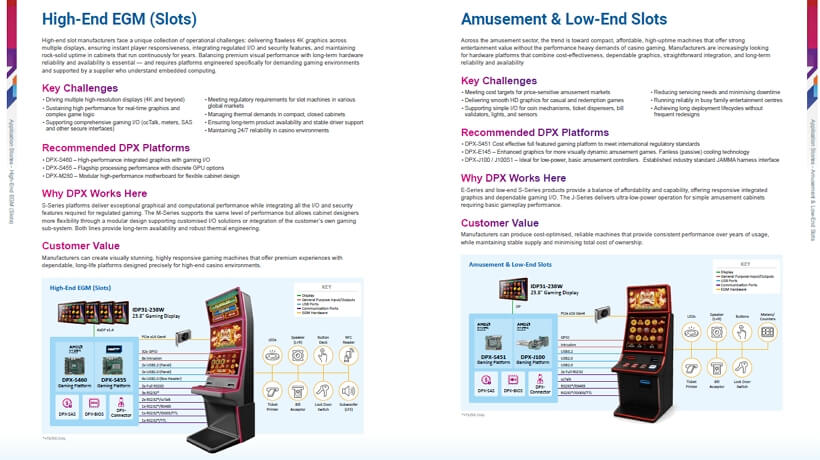
Platforms like the DPX-M280 and DPX-S460 are built to support those demands, offering up to four independent 4K displays, DDR5 memory, PCIe Gen4 expansion, and a full suite of gaming I/O, including GPIO and security interfaces.
Advantech’s focus, Craig explains, is ensuring performance keeps pace with those design ambitions while maintaining stability and compliance. “We support all that with higher-performance hardware, but I wouldn’t call it a step change.”
Built for Longevity, Backed by Scale
That philosophy of steady, reliable progress mirrors how the gaming division operates within Advantech itself. Despite being part of the world’s largest industrial PC company, Craig believes maintaining focus has been essential. “Advantech is head and shoulders the largest industrial PC company in the world with over two billion in sales, 7000 employees worldwide, 4000 products.”
Within that scale, gaming remains a specialist vertical. “While we’re a small part of the larger Advantech family, the gaming market demands specialised hardware and matching software, which is why we have a dedicated team” Craig explains.
While the gaming division leverages global resources, its autonomy has been protected. “Although we benefit from Advantech’s global resources, the gaming division maintains its own focus and autonomy.”
That focus has been preserved over time. “The great thing over the last 15 years that we’ve been part of Advantech is they’ve allowed us to recruit and maintain our team without getting diluted.” For Craig, this isn’t simply cultural preference but operational necessity. “Delivering our products successfully demands both expert knowledge and specialised support.”
Advantech’s commitment to vertical market specialisation has played a key role in enabling that balance. “Advantech has a corporate-down emphasis on vertical market specialisation which has benefited us enormously,” Craig notes.
Access to in-house manufacturing, compliance, and QA – much of it based in Taiwan – underpins that advantage. “Joining with Advantech seems a long time ago now but it’s been fantastic for us because now we have access to in-house manufacturing, in-house compliance, QA.”
Supply chain resilience is another critical factor, particularly as global component shortages persist. Craig points to Advantech’s sourcing scale as a differentiator. “Another key thing is the sourcing power of Advantech.”
“Because we have those 4000 products, the sourcing and component specialists that we have in Taiwan really help ensure that we’re selecting the right components for our products and that we can get hold of those components when there’s supply constraints.”
That capability is increasingly important amid constrained memory supply. “There is currently major global difficulty sourcing memory and flash storage, prices going through the roof and allocated supply,” Craig explains. “Because Advantech has specialists dedicated to ensuring product availability, we’re better positioned than many competitors to secure memory despite the constrained market.”
He points to recent experience as proof. “Going back to the pandemic it was the same thing. We were able to keep our products going, manufacturing and supplying them to our customers because of those resources that Advantech has.” For Craig, the equation is clear. “It’s a good combination – a small company focus with big company resources behind it.”
Dual-Platform Strategy
That same balance underpins Advantech’s long-standing dual-platform strategy across Intel and AMD – an area that has drawn attention as AMD has adjusted its approach to embedded gaming. Craig is unequivocal. “We’re not going to discontinue our AMD products.”
On the contrary, AMD’s relevance has increased for companies like Advantech. “AMD is key for broad market industrial PC companies like Advantech, even more so in the last year or so.” What has changed is the engagement model. “Even with the tier ones, AMD wanted them to lean on people like Advantech to get support.”
The rationale, Craig explains, is practical. “They weren’t going to offer direct support because it was running them too ragged to support all these customers, particularly in gaming who had special requirements.” Instead, support is delivered through partners. “They can get that support through companies like Advantech.”
As a result, AMD remains central to Advantech’s roadmap, with platforms like the DPX-M280 reflecting that commitment. “Our AMD product is just as strong as it ever was and getting stronger,” Craig stresses. “We continue to provide their top APUs, and graphics cards remain available through us.”
For Craig, the conclusion is straightforward. “They didn’t say they didn’t want any business in gaming; they just didn’t want to do it directly with the tier ones.”
At ICE Barcelona, Craig’s perspective reflects a broader industry truth: the future of regulated gaming hardware is being shaped less by sudden disruption and more by platforms built for longevity – capable of supporting higher performance, richer experiences, and compliance demands over long lifecycles.
For Advantech, progress is incremental, intentional, and firmly grounded in delivery.
This interview was first published by G3 Newswire, a leading global B2B publication for the international gaming industry. Read the original article here: 👉G3 Newswire: Advantech | Building for What Comes Next in Casino Hardware
![DPX-M280: Video Guide to Performance, Features, and Specs [Technical Walkthrough]](https://advcloudfiles.advantech.com/cms/f36c643e-fea8-4377-b92f-9f58ea3722f2/Video%20Featured%20Image%20Large/M280-thumbnail.jpg)