Key Takeaway
Explore how Edge AI empowers seamless real-time responses by leveraging local servers, enhancing safety, efficiency, and cost-effectiveness.

Introduction
As AI accelerates from research labs to everyday operations, its footprint now spans cloud-scale training, on-premises systems, and billions of connected devices. Yet most AI services still assume a stable network path to distant data centers. What if that link fails? Picture a self-driving car that suddenly reports “Network connection lost” and begins to drift off course, or a household robot that’s been compromised behaving unpredictably. These scenarios highlight a simple truth: connectivity is not guaranteed, especially where milliseconds matter.
Imagine you’re dozing in a self-driving car when the system suddenly warns, “Network connection lost,” and the vehicle begins to drift off its lane and straight toward a sheer drop. Or picture a household robot that’s been hacked, starts acting up and dancing, and even picks up a knife and walks toward you.
Is that the future anyone wants? Of course not. This is precisely why edge AI has become a hot topic. By running AI locally instead of depending solely on the cloud, systems can react in real time on site. It’s safer, lower-latency, and it lets data create value immediately as opposed to becoming a sunk cost.
What Is Edge AI?
At first glance, edge AI may sound like “an AI standing off in the corner,” but in reality, it’s the most reliable, most instantaneous digital partner right at our side. Today, on-prem servers in enterprises, hospitals, and schools, as well as personal computers and even smartphones, can all serve as edge nodes. When data is processed on these nodes, that’s edge computing; when AI models run on those nodes, that’s edge AI. Put simply, taking compute power that used to sit in far-off data centers and moving it closer to where data is born. Why do this? Isn’t it more convenient to keep data in the cloud for centralized management? Actually, that’s the problem.
When data is processed on edge nodes, we call it edge computing; when AI runs on those nodes, it’s called edge AI.
1) Physical limits: latency:
Even with light-speed signals, data traveling from the street corner near your home to a cloud data center thousands of kilometers away and back again must hop across multiple network nodes. That round trip can add tens of milliseconds of delay. For AI applications that demand instant reactions, for example a precisely controlled robotic arm on a production line, or an autonomous vehicle assessing road conditions, every millisecond affects safety and accuracy. Those delays, rooted in physical distance and network architecture, can’t be wished away.
2) Info-science & engineering constraints: bandwidth and cost
hink of bandwidth like pipe diameter. As high-resolution video and sensor streams surge back and forth, the data flood can overwhelm the pipe. To avoid gridlock, you’d have to keep expanding the pipe, i.e., buy more bandwidth, at eye-watering cost. If instead you preprocess at the edge and condense only the important bits before sending anything to the cloud, you lighten the bandwidth load and save substantial money.
3) System reliability and resilience:
If all computation lives in the cloud, what happens when the network gets flaky or goes down? Many safety- and security-critical applications, such as public safety monitoring or early-warning systems for essential equipment, can’t live at the mercy of the network. Edge processing makes systems more independent; even during outages, local AI can keep running and responding in real time. That’s a major engineering consideration.
In short, edge computing isn’t busywork for scientists, but a practical optimization shaped by data realities and real-world needs. If we want to capture the value of real-time data, edge computing is the way forward.
The Real‑World Appeal of Edge AI
So, we’ve moved AI compute to the edge. Where does edge AI truly shine? In delivering deep perception.
Deep perception isn’t just crunching numbers. Using complex AI models like deep neural networks, edge AI understands higher-level, more meaningful information from raw signals.
Take Advantech as an example. The company already runs many edge-AI solutions in production. In industrial defect inspection, object-detection models can rapidly pinpoint flaws on the line. Because the same model parameters are applied consistently, quality control is uniform and human slip-ups are reduced. In high-throughput factories where inspection must be fast, accurate, and consistent, Advantech’s system can process up to 8,000 items per minute, cutting labor needs while keeping quality steady. All that from an edge device about the size of a capsule coffee machine, the IPC-240.
In smart warehousing, Advantech teamed up with ADATA, integrating NVIDIA’s Nova Orin development platform into Advantech’s MIC-732AO serve to build AMR (Autonomous Mobile Robot) solutions. Unlike legacy AGVs (Automated Guided Vehicles), AMRs don’t need pre-mapped routes. With onboard sensors, they can dodge obstacles, recognize paths, and move goods to designated locations by nimbly navigating around whatever pops up.
And then there are language models. Combine Retrieval-Augmented Generation (RAG) with in-context learning, and beyond note-taking or scheduling you can capture hard problems from real work. When a similar issue crops up later, you can ask the AI for answers rooted in past context.
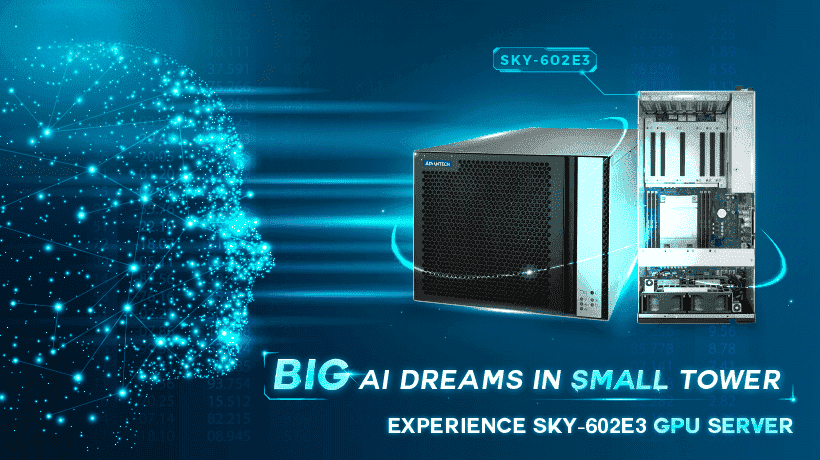
You might ask, “Why not just use ChatGPT?” For many enterprises, internal data is highly confidential or commercially valuable. Some facilities even ban phones completely, making cloud upload a non-starter. For organizations that prize security but still want AI-driven efficiency, self-hosted LLMs are ideal. And you don’t need a massive machine: Advantech’s SKY-602E3 tower GPU server is about the size of a backpack yet can comfortably support LLM operations to deliver an efficient, secure AI solution on-prem.
Of course, this raises another challenge: running a large model on a small box, won’t it be too resource-hungry? That’s one of today’s hottest research fronts: how to slim AI models scientifically without dulling their intelligence. Here’s how researchers put models on a diet.
Model Slimming #1: Quantization — A More Compact Digital Representation of Knowledge
With limited hardware and ever-growing models, “putting the model on a diet” is essential for edge AI. It’s like image compression: remove detail the eye can’t see to shrink file size without changing the overall look.
Quantization applies the same idea to parameters. These are typically floating-point numbers (the decimals we all know). Just as we often use 3.14 (or even 3) for π in everyday calculations, we can reduce the precision used to store parameters. Lower precision shrinks the model and its compute demands.
It isn’t trivial, though. Reducing precision does affect accuracy to some extent. Engineers therefore tune the process carefully to keep performance within acceptable bounds, slimmer without getting dumber.
Model Pruning: Structural Simplification
Building an AI model means constructing a neural network and training the parameters that link its neurons. Among the sea of parameters, some take up space without pulling their weight. Why not remove the deadwood?
It’s like weeding a garden. The weeds aren’t your crops, so you pull them. In large models, “weeds” are the low-value connections or neurons you can safely cut. That’s model pruning.
Pruning can shrink a model, for example, trimming 100 down to 70. Helpful, but not game-changing. If you want a model that’s orders of magnitude smaller, pruning alone won’t cut it. You need to start with a small model and teach it what the big model knows. Enter knowledge distillation, one of the most promising compression techniques today.
Knowledge Distillation: Teaching a Small Model the Master’s “Essence”
Picture a seasoned master craftsman (the large model) training a young apprentice (the small model). Instead of handing over answers, the master passes along how he thinks and why, including the probability distribution over possible outputs. The apprentice, with a smaller “brain,” still picks up the master’s core wisdom and performs far better than if it learned from scratch. Many highly efficient small language models are trained this way, ideally for deployment on resource-constrained edge devices.
Even so, to chew through live, high-volume data at speed, in real time reliably at the edge, you still need a strong engine.
The Strong Heart of Edge AI: Three Keys in the SKY-602E3
Advantech’s SKY-602E3 tower GPU server is a textbook example of an edge-AI engine. What makes it stand out?
1. Core compute:
It supports up to four double-width GPUs. Why do GPUs matter? They’re built for massive parallelism, exactly what modern AI workloads need. With multiple GPUs, you can run more AI tasks at once, or handle much larger data streams. This is the physical foundation for getting cutting-edge research to run, run fast, and do more simultaneously at the edge.
2. Engineering adaptability and tower design:
Edge sites aren’t pristine data centers. They might be a factory corner, an office closet, or a research lab. A tower chassis is relatively compact and offers better thermal headroom for power-hungry GPUs, making deployment more flexible than traditional rack servers. In short, it’s high-performance computing, engineered for Taiwan’s diverse edge environments.
3. Reliability:
With server-grade motherboards, ECC memory, and redundant power, the SKY-602E3 is built for stability. At the edge, uptime is everything. You don’t want your analysis crashing mid-job. These choices ensure long-running, steady operation, turning lab results into dependable, real-world value. (Advantech notes that the SKY-602E3 is roughly backpack-sized yet supports LLM workloads, enabling efficient and secure on-prem AI.)
Made in Taiwan × Local Expertise: Building Tailored Edge-AI Solutions
Advantech has partnered with D8AI to deliver custom AI solutions for enterprises and institutions. Their combined strengths span natural language processing, computer vision, predictive big-data analytics, full-stack software development and deployment, and AI hardware-software integration.
Whether it’s fine-tuning large or small LLMs, training models for industrial defect detection, or big-data analysis, Advantech and D8AI can help. They even offer GPU and server rentals, lowering upfront costs and making it easier to get AI projects off the ground.
Taiwan’s unique industrial landscape, from precision manufacturing and urban traffic management to smart healthcare for an aging society and public safety, is ideal for edge-AI adoption. Crucially, many of these scenarios involve time-critical information: a production anomaly, a sudden road incident, or an immediate medical alert, each demands split-second response.
If we must ship data to the cloud and wait for results, we often miss the golden moment to act. That’s why edge AI is more than a tech innovation, it’s a key route to making advanced AI real, boosting productivity and creating social value. By enabling data to be understood and used the instant it’s generated, on site, edge AI becomes the philosopher’s stone that turns data trash into data gold.