Key Takeaway
Learn how AI-driven edge computing transforms retinal imaging workflows, tackling data, latency, and reliability in modern ophthalmic diagnostics.
Intro
High-resolution retinal imaging—such as fundus photography and Optical Coherence Tomography (OCT)—is critical for the early detection and diagnosis of vision-threatening conditions. To capture, process, and render volumetric diagnostic scans in real time, modern ophthalmic systems demand reliable edge computing architectures that combine robust processing power, high-speed data transmission, and flexible hardware expansion.
Challenges
Modern ophthalmic imaging workflows present several critical technical challenges:
- Image Quality Variability: Clinical accuracy requires immediate algorithmic enhancement to correct uneven illumination, motion artifacts, and patient blink disruptions.
- Massive Data Throughput & Storage: Ultra-high-resolution 3D volumetric scans generate immense data payloads, creating bottlenecks in local data buffering, transfer, and archival.
- Compute-Intensive Edge Latency: Running complex noise-reduction algorithms and AI segmentation models simultaneously demands low latency without causing thermal throttling in compact diagnostic equipment.
Solutions and Technologies
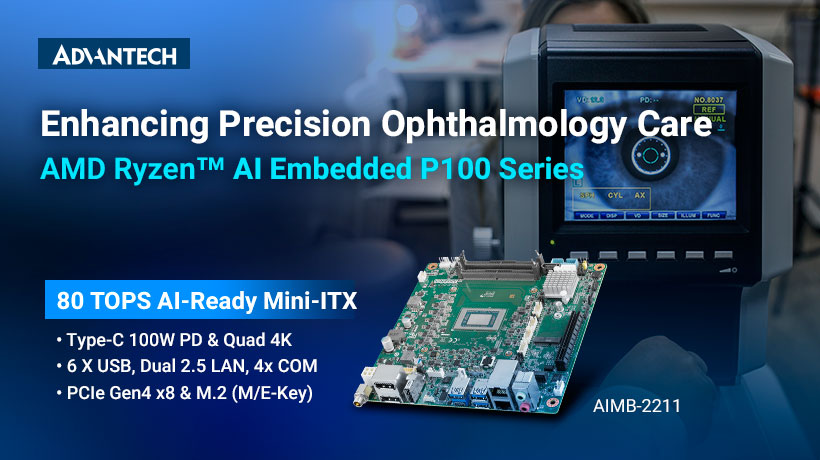
The Advantech AIMB-2211 leverages AMD Ryzen™ AI Embedded P100 Series processors to deliver high-performance, energy-efficient computing for next-generation edge AI and industrial applications. Built on AMD's latest "Zen 5" architecture, the P100 Series scales up to 12 CPU cores and integrates a heterogeneous compute design that combines CPU, GPU, and NPU acceleration, enabling up to 80 total system TOPS for real-time AI inference and physical AI workloads.
Benefits
- Advanced computing cores optimize the processor workload.
- Improves and maintains consistent image quality.
- Accelerates clinical decision making.
-50/未命名20260610164837.png)