

Key Takeaway
Modular iDAQ offers a flexible, scalable DAQ solution for edge applications like NVH, structural monitoring, and PHM. It supports diverse sensors, high-speed sampling, synchronized expansion, and easy integration via free DAQNavi SDK with broad language support.
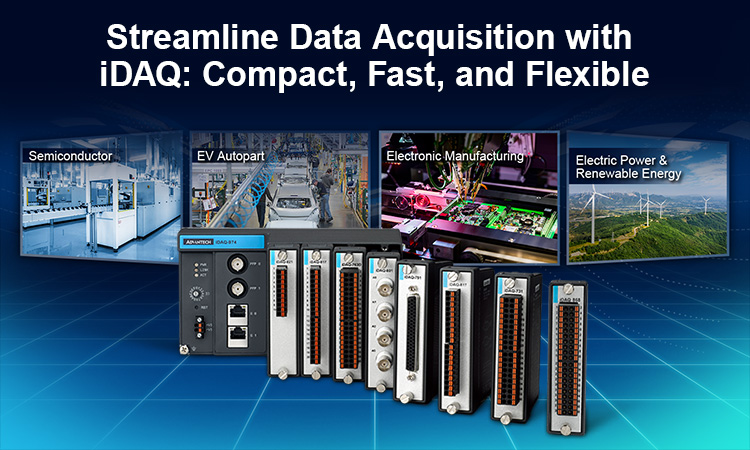
1. How does modular iDAQ compare to embedded DAQ cards, and why is the industry shifting toward this approach?
With edge computing on the rise, the industry is shifting to modular DAQ systems as they offer flexibility, scalability, and edge-ready design. Modular iDAQ captures and processes data closer to the source, reducing latency, boosting reliability, and simplifying expansion in demanding environments, while embedded cards remain ideal for fixed PC-based setups.
2. Which applications are better suited for modular DAQ vs. embedded DAQ cards?
Modular DAQ excels in edge-side test and measurement applications such as NVH and acoustic analysis, structural strain monitoring, battery cycling, end-of-line functional checks, and predictive-health (PHM) diagnostics; whereas embedded cards are better suited for fixed, PC-based systems requiring high channel density within a single enclosure.
3. What kind of sensors can iDAQ system connect to?
The iDAQ system offers a wide range of modules for different types of signal source. You can connect voltage, IEPE/ICP, strain gauge based sensors (quarter-bridge, half-bridge, and full-bridge), load cells, thermocouple, RTD, LVDT, and current. Refer to individual iDAQ specification for more information.
4.What's the sampling rate offered by iDAQ system?
Each iDAQ module provides different sampling rate. Their range is from lowest 10S/s (high resolution mode of iDAQ-815 & iDAQ-868) to the highest 1MS/s/ch (iDAQ-841). Refer to individual iDAQ specification for more information.
5. How does iDAQ system achieve timing synchronization across modules in the base unit?
There are two aspects, in terms of the timing synchronization. First is the physical hardware layer, the backplane in the base unit connects all the signal together. On the other hand, in the software configuration layer, Advantech designed Device Fusion function to configure the modules requiring synchronization to a virtual device that all the settings would simultaneously apply to all the modules, synchronize every module together.
6. How scalable is the iDAQ system? Can I expand it later?
iDAQ supports modular expansion. You can scale your system by adding more I/O modules to the existing chassis or connecting multiple chassis via USB or Ethernet while maintaining synchronized data acquisition through Advantech’s Device Fusion.
7. How do I implement the iDAQ system with my existing system in software? Is the software free-of-charge?
Advantech provides DAQNavi SDK that includes API, software manual, utilities for helping you through from device testing to system integration. You can integrate the iDAQ system with the programming using DAQNavi API. It provides all the essential interfaces to configure and get data from the modules. And of course, the DAQNavi SDK is free-of-charge.
8. What kind of programming languages does iDAQ support?
iDAQ is supported by DAQNavi. The supported programming languages are: C, C++, QT, C#, VB.NET, Python, Java, MATLAB, LabVIEW.
9. What are the options available if I need a flexible or more specific DAQ solution besides iDAQ?
In addition to iDAQ, we offer a range of DAQ solutions to fit different needs, including Plug-and-Play USB DAQ Modules and DAQ Cards. These alternatives provide flexible, easy-to-install options for various applications, allowing you to choose the best fit based on your specific testing requirements and system setup.