Key Takeaway
Discover how Advantech's AIR-030 with NVIDIA JetPack 7.2.1 optimizes LLMs, boosting throughput by 4.4× while cutting memory use by 69%.
Advantech tested LLM optimization on the AIR-030, powered by NVIDIA® Jetson AGX Orin™ 64GB and NVIDIA JetPack™ 7.2.1. Advantech combines Q4_K_M model quantization with NVIDIA Jetson Agent Skills for memory auditing, runtime tuning, benchmarking, and verification on AIR-030. The test environment included CUDA 13.2.1, Jetson Linux 39.2.1, Ubuntu 24.04, and Kernel 6.8.
Quantization plus an audit, tune, benchmark and verify workflow moved three LLMs to 2.2–4.4× higher throughput while using 60–69% less peak LLM runtime memory. Here are the measured results.
Benchmark data measured on Advantech AIR-030 | NVIDIA Jetson AGX Orin 64GB | JetPack 7.2.1 by Advantech
Key results
• Qwen3.5 27B peak LLM runtime memory fell from 53.3 GB to 16.7 GB, a 68.7% reduction, and throughput rose 4.38× (1.71 to 7.49 tokens/s).
• Qwen3.5 9B ran 2.28× faster while its peak LLM runtime memory dropped from 18.2 GB to 6.0 GB.
• Nemotron-3-Nano-4B ran 2.21× faster and its peak LLM runtime memory fell from 8.7 GB to 3.5 GB.
• The 27B model in BF16 used 53.3 GB of the 64 GB module. After optimization it left room for other workloads.
Why Memory Efficiency Matters at the Edge
Large language models and vision-language workloads are moving from cloud environments to edge AI systems. However, edge deployment is constrained by available system memory, thermal limits, power budgets, and the need to run complete application stacks locally. For real-world applications such as vision AI, factory automation, autonomous machines, and private LLM services, model performance alone is not enough. The system must also preserve memory headroom for runtime services, camera pipelines, databases, orchestration software, and user applications.
NVIDIA JetPack 7.2 provides the agentic developer toolfor Jetson. It includes a set of Jetson Agent Skills that help an AI Agent audit, tune and benchmark memory use directly on the device. Advantech tested this approach on AIR-030 that provides an edge AI platform for these workloads by combining NVIDIA Jetson AGX Orin 64GB with multi-camera I/O. In this test, Advantech evaluated how model quantization and runtime tuning can reduce the memory footprint while improving inference throughput.
Test Platform and Architecture
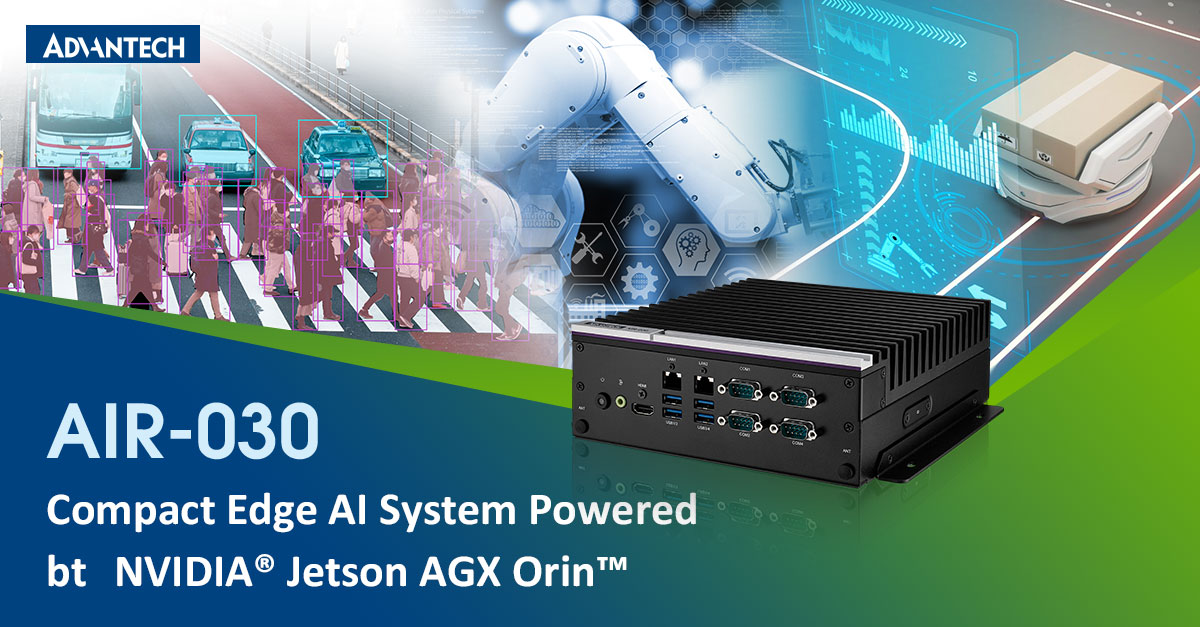
The AIR-030 test platform is powered by NVIDIA Jetson AGX Orin 64GB and runs NVIDIA JetPack 7.2.1 with Jetson Linux 39.2.1, Ubuntu 24.04, and Linux kernel 6.8. CUDA 13.2.1 provides the GPU compute runtime, while llama.cpp serves the tested models in GGUF format.
The optimization workflow combines model quantization with three NVIDIA Jetson Agent Skills, applied consistently across all tested models: ● jetson-memory-audit measures system memory usage and compares the memory footprint before and after optimization.
● jetson-inference-mem-tune optimizes runtime memory allocation, KV cache, context settings, and memory reservation.
● jetson-llm-benchmark validates inference throughput and latency after memory tuning to ensure that performance does not regress.
The order matters. Auditing first shows where memory is actually going. Tuning then targets those areas. Benchmarking and verification confirm that memory savings were not bought with lost speed. Advantech integrated this optimization and validation workflow with model quantization on the AIR-030 platform, creating a repeatable process for improving LLM performance and memory efficiency on real edge AI hardware
Benchmark Results: Higher Throughput with Lower Memory Usage
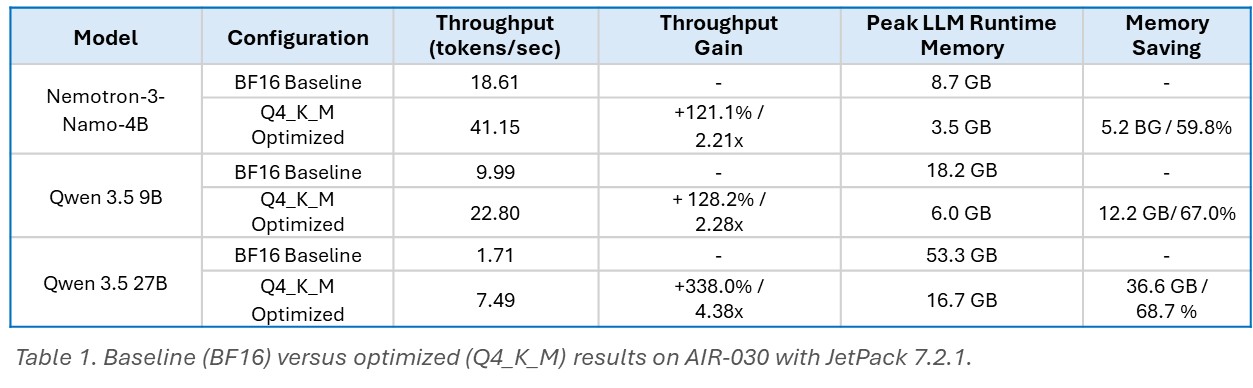
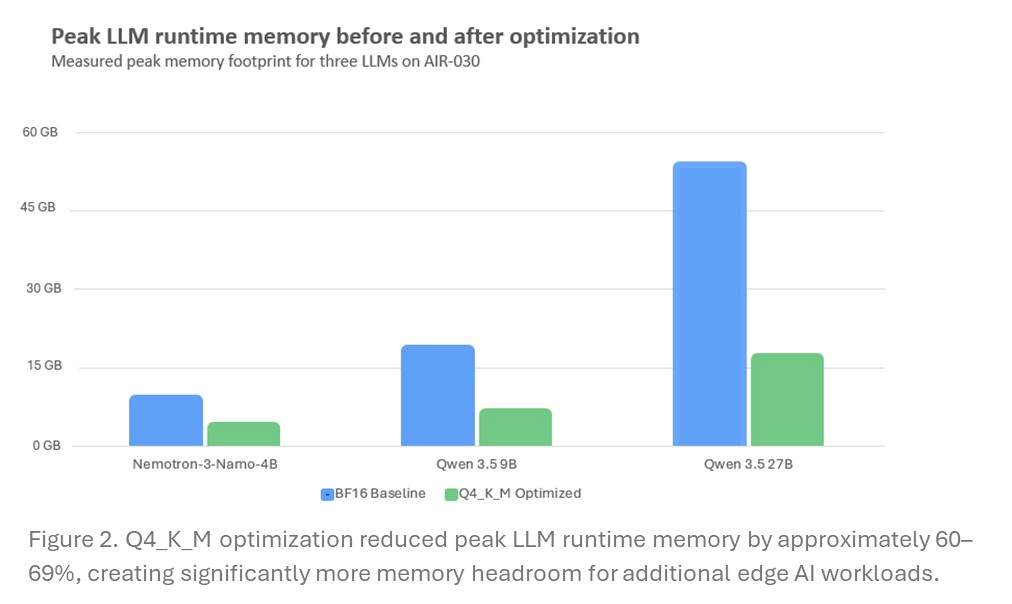
Advantech benchmarked three LLMs on AIR-030 powered by NVIDIA Jetson AGX Orin 64GB, comparing BF16 baseline configurations with Q4_K_M optimized models with NVIDIA JetPack 7.2.1(Table 1). Across all three workloads, optimization delivered significant improvements in both inference throughput and peak LLM runtime memory usage.
Nemotron-3-Nano-4B increased from 18.61 to 41.15 tokens/sec, delivering 2.21× higher throughput, while peak LLM runtime memory decreased from 8.7GB to 3.5GB, a 59.8% reduction. Qwen 3.5 9B improved from 9.99 to 22.80 tokens/sec, or 2.28× higher throughput, while memory usage dropped from 18.2GB to 6GB, reducing the footprint by 67.0%.
The largest improvement was observed with Qwen 3.5 27B. Throughput increased from 1.71 to 7.49 tokens/sec, representing a 4.38× improvement, while peak LLM runtime memory decreased from 53.3GB to 16.7GB, saving 36.6GB, or 68.7%.
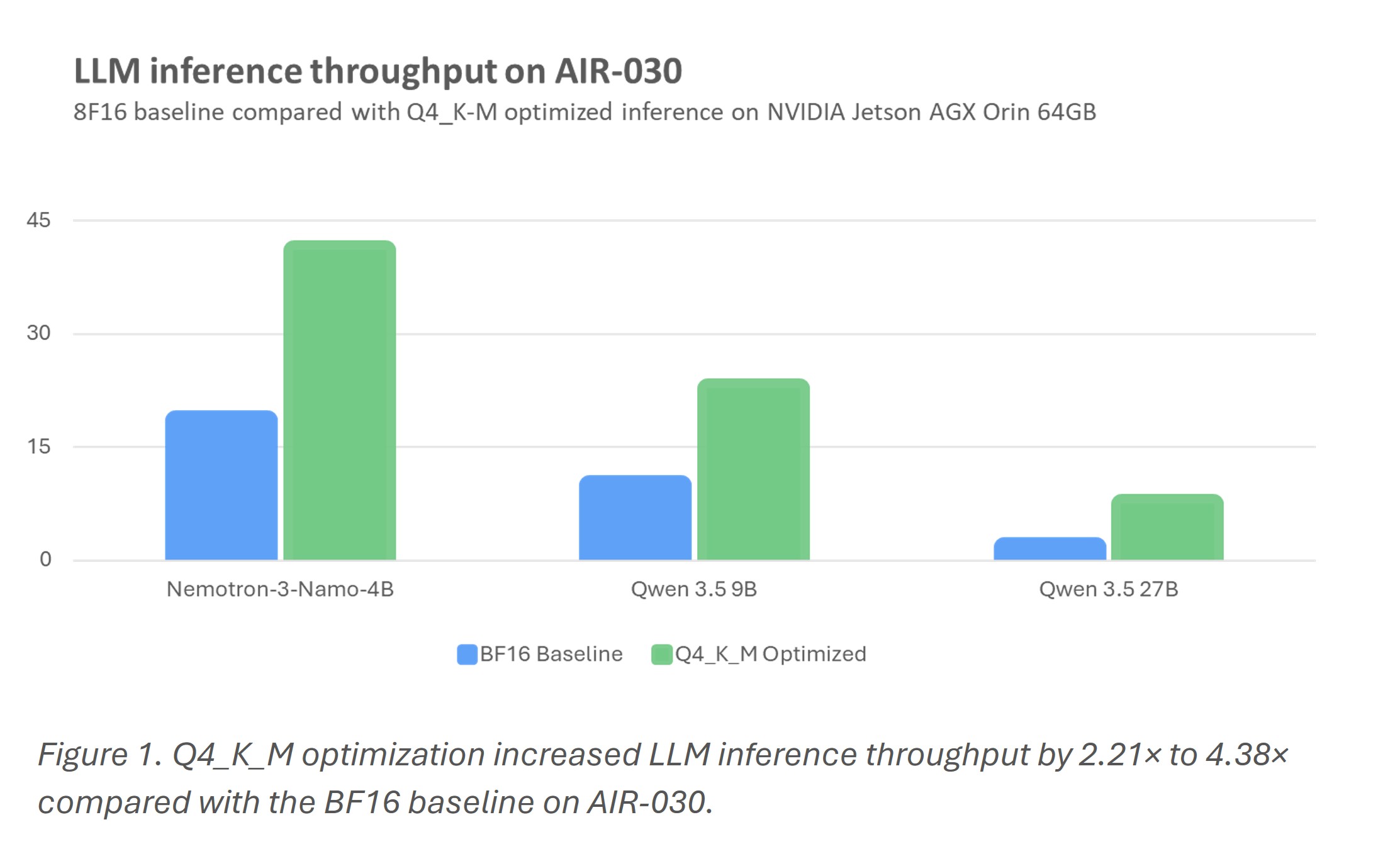
The benchmark shows that memory optimization changes how edge AI systems can be sized and deployed. Instead of selecting hardware based only on the raw memory requirement of an unoptimized BF16 model, developers can use quantization, runtime tuning, and memory auditing to fit larger models into practical edge deployments. For the AIR-030, the most important result is the ability to preserve memory headroom while improving throughput. This is especially important for real deployments where the AI model runs alongside camera ingestion, application logic, device management, storage, and user interfaces. The Qwen 3.5 27B result is particularly meaningful because the baseline used 53.3GB, while the optimized version used only 16.7GB. This creates room for additional services or multi-model workloads on the same platform.
What the Results Mean for Edge AI Deployment
Advantech AIR-030 with NVIDIA JetPack 7.2.1 provides a practical platform for deploying optimized LLM workloads at the edge. The test results confirm that Q4_K_M quantization and NVIDIA Jetson Agent Skills can significantly reduce memory usage while increasing tokens/sec performance. Across the three tested models, throughput improved by 2.21× to 4.38×, while memory usage decreased by 59.8% to 68.7%. These results show that AIR-030 can support more capable edge AI workloads without relying only on larger system memory or cloud inference. For developers building vision AI, industrial AI agents, local LLM services, or multi-camera edge applications, this approach provides a repeatable path: audit memory, tune runtime settings, benchmark performance, and verify the final deployment envelope on real hardware.
Deployment implications
• Platform sizing flexibility. Before optimization, the Qwen3.5-27B BF16 model required a 64GB-class Jetson platform due to its 53.3GB memory footprint. After Q4_K_M optimization, peak runtime memory was reduced to 16.7GB, making deployment on a 32GB-class Jetson platform technically feasible.
• Higher model density. A 64 GB module can host a larger model, or several smaller ones, than a BF16 budget would suggest.
• Data stays local. Inference on the device keeps video and sensor data on site, helping protect data privacy and reduce exposure to external networks while reducing cloud bandwidth and latency.
• Repeatable process. Because the skills run as a defined loop, the same audit, tune, benchmark and verify steps can be repeated for each new model and each JetPack release.
Advantech Enables More Efficient Edge AI Deployment
The benchmark demonstrates that edge LLM deployment is not only a question of model size. Runtime selection, quantization, KV cache tuning, context configuration, and memory reservation all directly affect how efficiently a workload can run on an edge AI system. With NVIDIA Jetson AGX Orin 64GB, CUDA 13.2.1, llama.cpp, and NVIDIA Jetson Agent Skills, the Advantech AIR-030 achieved significant improvements in both throughput and memory efficiency. The results show that AIR-030 is well suited for optimized local LLM and edge AI deployments where performance, memory headroom, and system integration must be carefully balanced in production environments.
As an NVIDIA Elite Partner, Advantech delivers a broad portfolio of industrial AI platforms powered by NVIDIA Jetson. Purpose-built for real-world AI deployment, Advantech solutions combine rugged industrial-grade design, software toolkits, design-in services, global R&D support, and long product lifecycles to accelerate scalable AI adoption across manufacturing, smart cities, healthcare, and robotics.
With validated DRAM integrated directly on-module, NVIDIA Jetson helps eliminate the need to source, qualify, and design with external memory. Combined with NVIDIA JetPack 7.2, Advantech’s comprehensive and scalable NVIDIA Jetson-powered portfolio—from Jetson Orin Nano™ to Jetson AGX Thor™—supports optimized runtime inference for leading open generative AI models and robotics applications.
Learn more about Advantech’s NVIDIA Jetson-powered solutions: https://campaign.iotmart.com/edge-ai_Nvidia
-50/AIR-075_03--(1)20260504114713.png)
-50/2026-02-23_05322220260223054242.png)
-50/AIR-020R_04-20250818161842.png)
-50/AIR-030_04--20230601175550.jpg)