Revolutionizing Eye Care with Optical Coherence Tomography on the Advantech MicroATX AIMB-588 B1
2025/12/30
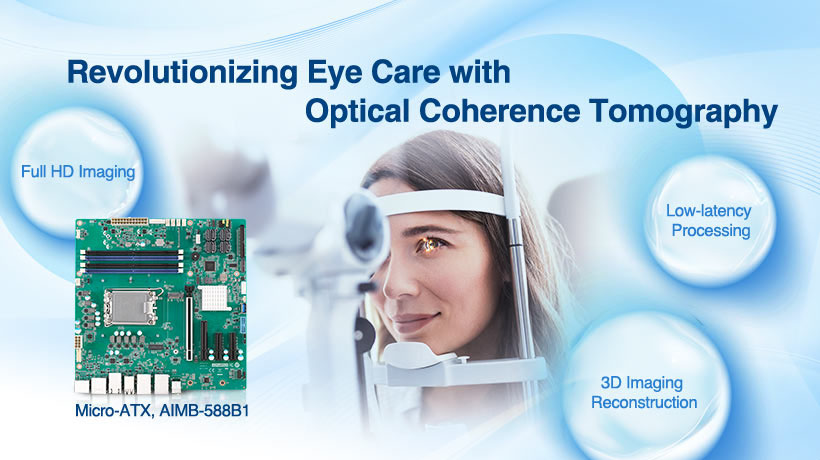
Optical Coherence Tomography (OCT) is a non-invasive imaging technology that uses light to generate high-resolution, cross-sectional views of internal eye structures, offering micrometer-level detail beyond what conventional imaging modalities can achieve. OCT plays a critical role in diagnosing retinal disorders, tracking glaucoma progression, and supporting early disease detection.
Challenges & Demands
As OCT systems evolve, they must capture and process more data at higher speeds while maintaining uncompromised image accuracy. Modern OCT platforms face several challenges:
High-Speed Full HD imaging
Increasing A-scan rates and wider fields of view, requiring greater data throughput and stability
Demand for 3D imaging
Which significantly raises computation and memory requirements for volumetric reconstruction
Low-latency processing
Reducing motion artifacts and support real-time clinician feedback.
Solution: MicroATX Motherboard AIMB-588 B1
To power next-generation OCT systems, the customer chose the Advantech AIMB-588 B1 industrial motherboard as their processing platform. Featuring a high-performance CPU, ample DDR5 memory, and extensive I/O options, the AIMB-588 B1 efficiently handles optical signal data, supports high-speed data transfer, and executes computationally intensive reconstruction tasks.
1. Optimized Processing Pipeline for High-Speed A-Scan Acquisition
OCT imaging relies on the A-scan rate, which dictates how many depth profiles can be captured per second. The AIMB-588 B1 optimizes the capture efficiency by leveraging:
‧ Intel® 12th, 13th, and 14th Gen Core™ & Core™ 200S processors for fast signal processing and data handling
‧ Multi-core architecture for concurrent processing of multiple signal streams
‧ Reliable and efficient computation to support timely data processing
2. High-Bandwidth Path for Optical Data Throughput
OCT systems require high-speed data transfer and large memory capacity to handle intensive optical signal workloads. The AIMB-588 B1 provides the following hardware support:
‧ PCIe x16 Gen5/Gen4 expansion for high-bandwidth add-on cards.
‧ Up to 192GB DDR5 memory for buffering and managing large datasets.
‧ High-speed data handling to enable efficient processing and transfer of optical signals
3. Dedicated Computing Resources for 3D Volume Reconstruction
3D OCT imaging requires transforming millions of A-scans into volumetric datasets. AIMB-588 B1 improves this process by enabling:
‧ PCIe expansion for GPU-enabled volumetric data processing and rendering
‧ High-efficiency CPU computation for interpolation, denoising, and segmentation
‧ Real-time synergy between CPU, GPU, and memory subsystems
4. Multi-Display Visualization for Clinical and Analysis Workflows
OCT systems often present imaging results across multiple views—live imaging, retinal thickness maps, layer segmentation, and 3D visualization. AIMB-588 B1 supports this with:
‧ Up to four independent 4K displays
‧ Multiple high-speed USB 3.2 ports for peripheral sensors
‧ Three 2.5GbE LAN ports for fast instrument control and data offloading
Conclusion: The Future of Optical Coherence Tomography
By leveraging the MicroATX AIMB-588 B1, featuring high-performance Intel® Core ™ processors, up to 192GB DDR5 memory, and GPU-accelerated computing, innovators successfully developed a next-generation OCT platform that delivers high-speed optical data acquisition, real-time 3D reconstruction, and ultra-low-latency image processing, setting a new standard for precision, speed, and reliability in ophthalmic diagnostics.
-25/AIMB-588_04-20251218151713.png)