Key Takeaway
Discover how Advantech's AMAX platforms redefine automation with high-speed I/O, software-defined control, and industrial-grade reliability.
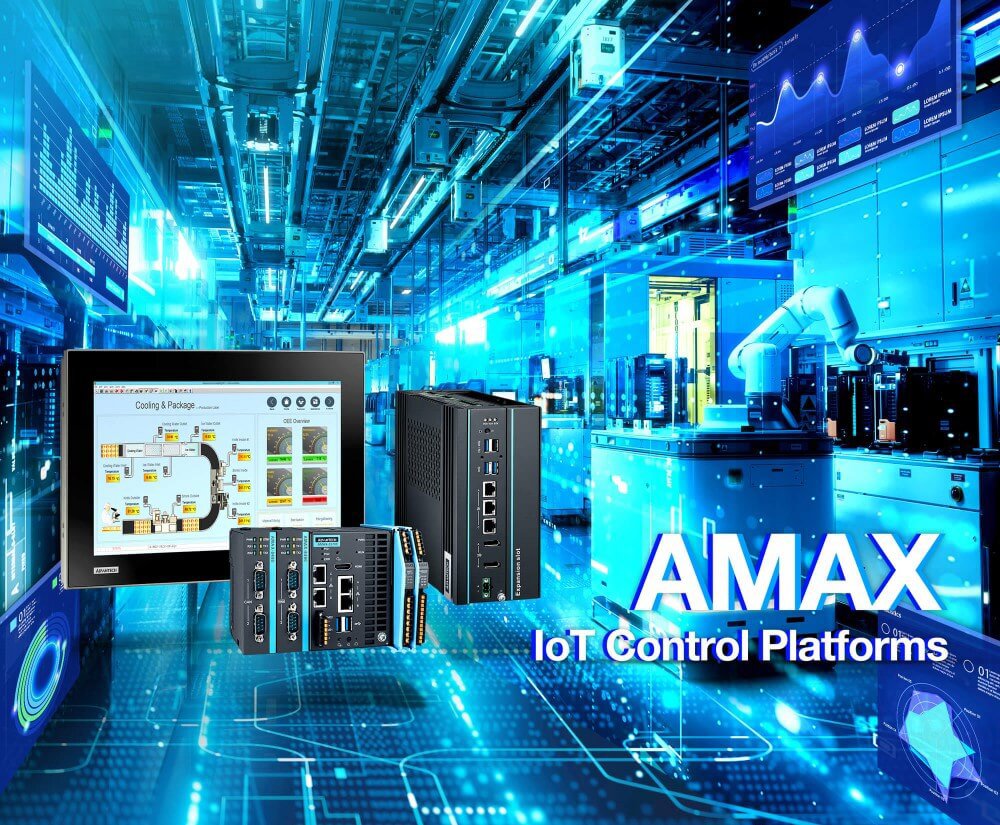
Advantech delivers software-defined computing that addresses today's performance needs and tomorrow's security, compliance, and integration challenges
The automation landscape has undergone fundamental transformation. Modern manufacturing facilities integrate vision systems processing gigabytes of image data, motion controllers coordinating dozens of axes in real-time, and edge analytics extracting insights from continuous sensor streams. Yet computing infrastructure hasn't necessarily evolved to match these escalating demands.
This creates a strategic tension. Proprietary automation platforms promise integrated solutions with guaranteed compatibility—but at the cost of flexibility. Open computing architectures offer unlimited software choices—but often lack the optimization that manufacturing environments demand. The question isn't which extreme to choose, but whether both attributes can coexist within a single platform approach.
When Data Volume Exceeds Infrastructure Capacity
The I/O bottleneck manifests in unexpected ways. A European automotive supplier discovered this when implementing optical inspection across their assembly line. The vision system processed images and identified defects flawlessly during testing. Yet in production, inspection speed couldn't match line speed. The constraint wasn't the cameras or algorithms—it was the industrial PC's inability to move data fast enough from sensors through processing to control systems.
This scenario repeats across industries; PCB manufacturers attempting 100% optical inspection at production speeds, pharmaceutical packaging lines validating every unit through multiple cameras, solar panel production verifying cell quality through electroluminescence imaging. The common thread: data volumes exceeding what traditional industrial computing architectures can handle.
Advantech AMAX platforms are designed specifically to overcome these limitations, providing extensive high-speed I/O options: multiple 10GbE network interfaces supporting high-resolution camera arrays, flexible PCIe expansion slots accommodating specialized data acquisition cards, and dedicated interfaces supporting industrial Ethernet protocols like EtherCAT, PROFINET, and EtherNet/IP. These capabilities aren't peripheral features—they're core architectural elements.
The I/O architecture is optimized for simultaneous multi-directional data flows. When vision systems transmit images over high-speed networks, motion controllers coordinate actions through real-time buses, and sensor arrays report status through data acquisition cards, the platform maintains full bandwidth and deterministic timing for each channel—determining manufacturing system limits in inspection speed, control precision, and response time.
The Evolution of Control Architecture: From Dedicated Hardware to Software-Defined Systems
Manufacturing is experiencing a subtle but significant architectural shift. Traditionally, control functions were bound to dedicated hardware—PLCs executed logic control, motion controllers handled servo coordination, and specialized controllers managed process parameters. This architecture was clear but rigid.
Contemporary manufacturing applications challenge this segmentation. When quality inspection requires integrating machine vision AI, when process optimization demands real-time analysis of massive sensor data streams, when equipment must simultaneously handle control logic and data analytics, the limitations of traditional control architectures become apparent.
This architectural evolution is accelerated by intensifying cybersecurity requirements. As manufacturing systems connect more extensively to enterprise networks and cloud platforms, regulations like the EU Cyber Resilience Act mandate security capabilities that legacy dedicated controllers struggle to provide. Software-defined control on general-purpose platforms addresses this through rapid security patch deployment, adaptable encryption mechanisms, and expandable monitoring capabilities—transforming the platform architecture itself into a security enabler rather than a constraint. Equally important is continuous vulnerability management—the systematic monitoring, assessment, and remediation of security issues throughout a product's operational life. This proactive approach, combined with transparent disclosure practices, ensures manufacturers can respond to emerging threats rather than remain vulnerable to known exploits.
Software-defined control represents the migration of control functions from dedicated hardware to software running on general-purpose computing platforms. Soft PLCs execute on industrial PCs, delivering the determinism of traditional PLCs but with greater computing power, software flexibility, and security adaptability. Virtualized controllers allow multiple control instances to share hardware resources while maintaining isolation boundaries important for both performance and security.
AMAX platforms are particularly well-suited to this evolution, providing the computing resources required to execute soft PLCs or virtualized controllers while delivering reliability and real-time performance comparable to traditional PLCs. Real-time operating system support ensures deterministic execution. Extensive I/O options maintain direct connections with field devices. Industrial-grade design guarantees 7×24 operational stability. The standard x86 architecture enables deployment of contemporary security tools, encryption protocols, and compliance monitoring capabilities that evolving regulations demand.
This isn't about completely replacing traditional PLCs, but providing an alternative path—one that accommodates current control requirements alongside the security, compliance, and adaptability requirements of increasingly connected manufacturing environments.
Flexible Support Across Control Paradigms
Manufacturing facilities rarely achieve perfect architectural consistency. They evolve—new equipment integrates with existing systems, control strategies adapt as processes mature, automation capabilities expand incrementally. This creates "control heterogeneity": multiple control methodologies coexisting within single facilities, often within single production lines.
AMAX's approach provides unified computing platforms capable of simultaneously supporting multiple control paradigms. The platforms offer not just adequate computing resources, but appropriate execution environments. Soft PLCs can run in standard Windows environments, while the platform also supports real-time Linux kernels to satisfy deterministic control requirements. For scenarios requiring virtualized deployment, the platform's hardware virtualization support allows multiple control instances to share resources without interference.
This controller flexibility extends to the hardware level. AMAX platforms provide diverse expansion options—from support for legacy PCI interface cards maintaining compatibility with older control hardware, to latest-generation PCIe Gen 4 high-speed expansion slots supporting next-generation motion control cards and high-speed I/O, to modular I/O configurations allowing different interface types to be combined based on actual requirements.
This represents operational flexibility: machine builders can develop using familiar control software without hardware compatibility concerns, system integrators can freely select the most appropriate control solution for specific applications, and end users can standardize hardware platforms even while their production lines employ different control strategies.
Open Integration in Practice
When computing platforms are tightly coupled to specific software ecosystems, each integration becomes custom work requiring specialized connectors and translation layers. AMAX platforms provide standardized, open interfaces that diverse software can use directly.
This openness operates at multiple levels. At the hardware level, platforms employ standard x86 architecture, ensuring compatibility with virtually all industrial software. At the operating system level, platforms support Windows, Linux, and real-time OS variants simultaneously. For networking and communications, AMAX platforms natively support multiple industrial protocols through appropriate hardware interfaces and drivers—not software translation layers. OPC UA communications connect seamlessly with existing SCADA systems. EtherCAT or PROFINET interfaces allow platforms to participate directly in real-time control networks.
In practical deployment, this openness translates to tangible advantages. Consider an application requiring integration of vision inspection, motion control, and data analytics. A proprietary platform might require vision software supported by that vendor, specific motion control libraries, and compatible analysis tools—each element constrained to a single ecosystem.
AMAX platforms allow different selection paths: choosing the most suitable vision inspection software regardless of vendor, pairing it with proven motion control solutions, combining with open-source or commercial analytics tools. These heterogeneous components collaborate on a single platform through standard interfaces, without requiring complex intermediary layers.
Furthermore, AMAX's open platform approach extends to customization capabilities. When standard configurations can't fully satisfy specific requirements, the platform's modular design allows customized configurations to be delivered within 4-6 weeks—far faster than ground-up custom projects, while retaining the long-term support advantages of standardized platforms.
Industrial-Grade Open Platforms
Manufacturing environments demand more than functional capability from computing equipment. AMAX platforms are designed considering industrial realities: wide operating temperature ranges, vibration-resistant structures, and thermal management optimized for 7×24 continuous operation.
The combination of these industrial-grade characteristics with open platform capabilities creates a distinctive value proposition. Manufacturers don't choose between software flexibility and hardware reliability—they obtain solutions delivering both.
As manufacturing integrates technologies from multiple domains—traditional automation, industrial IoT, edge computing, artificial intelligence—computing infrastructure must be both flexible and robust. AMAX platform architectural decisions—from extensive I/O options to diverse controller support, from open software compatibility to industrial-grade reliability—are made specifically to enable rather than obstruct this convergence.